
Foreword
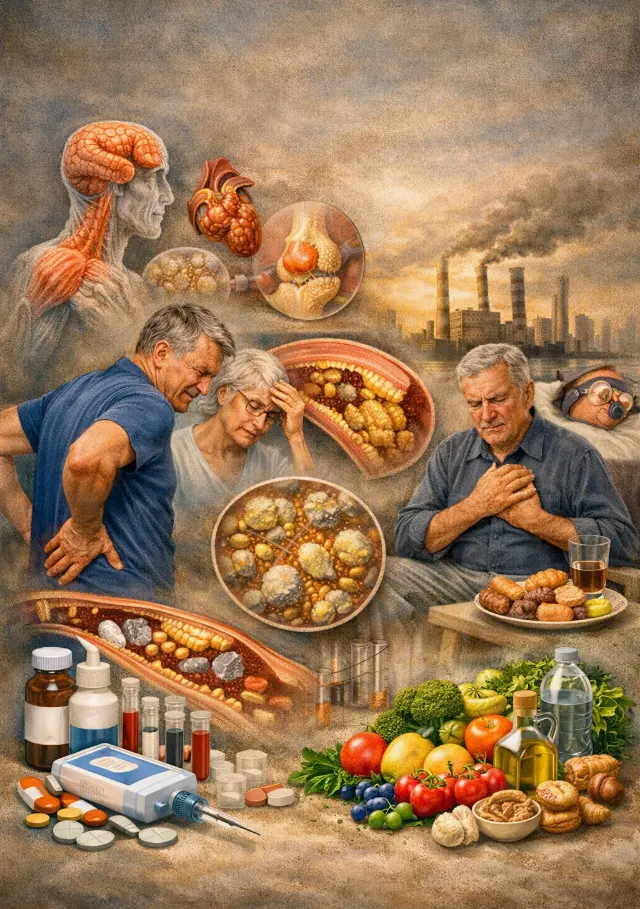
Aging is a universal phenomenon, inherent in the very nature of life. Yet it cannot be reduced to biological inevitability: above all, it reflects a gradual accumulation of waste in the tissues. Over the years, dietary and metabolic waste accumulates, overwhelms enzymes and disrupts cellular regeneration. Organs lose their functional coherence, tissues deteriorate and signs of aging appear.
Conventional medicine describes aging as a consequence of natural wear: loss of arterial elasticity, changes in cell membranes, accumulation of free radicals, protein glycation, clouding of the lens, and slowing of digestive and liver function. These observations are accurate, but they are not sufficient to explain the coherence of the process or to offer effective prevention.
From the perspective of accumulation-related disease, aging is the direct consequence of chronic overload. Cooked fats, dairy products and refined sugars overwhelm enzymes, disrupt biological signals and weaken tissues. Arteries become tortuous and rigid, cells undergo oxidation, the eyes become cloudy, and waste accumulates in the liver and digestive tract. Aging is therefore not simply a genetic inevitability, but the expression of an overloaded and weakened internal environment.
The ancestral or hypotoxic diet offers a promising response. By excluding dairy products, cooked fats and refined sugars, and favoring raw virgin oils, fresh fruit and vegetables, and gentle cooking methods, it lightens the workload of enzymes and restores biological coherence. Clinical observations show that aging can be slowed: arteries retain their elasticity, cells withstand free radicals better, the eyes remain clear, and digestion remains efficient.
This Family Clinic booklet offers a new interpretation: understanding aging as a gradual accumulation of waste in the tissues, and showing that dietary reform can slow it down. It delivers a message of hope: a long and healthy life is not an unattainable dream, but a possible reality when diet respects human enzymatic capacities.
Arterial aging
Arterial aging is one of the most visible markers of the passage of time. Arteries, initially supple and elastic, gradually become rigid, tortuous and fragile. This loss of elasticity leads to higher blood pressure, reduced blood supply to organs and increased cardiovascular risk. Patients experience fatigue, breathlessness, palpitations and sometimes chest pain.
Conventional medicine explains this phenomenon through the natural wear of tissues, the accumulation of lipid and calcium deposits, and the central role of atherosclerosis. Atheromatous plaques, made up of oxidized cholesterol and cellular debris, obstruct arteries and promote vascular events. This view is accurate, but it does not account for the overall coherence of arterial aging.
From the perspective of accumulation-related disease, arterial aging reflects chronic overload. Cooked fats, dairy products and refined sugars overwhelm enzymes, disrupt biological signals and weaken vessel walls. Waste accumulates in the endothelium, causing inflammation and rigidity. Atherosclerosis is therefore not a genetic inevitability, but the consequence of an overloaded and weakened internal environment.
The ancestral or hypotoxic diet offers a promising response. By excluding dairy products, cooked fats and refined sugars, and favoring raw virgin oils, fresh fruit and vegetables, and gentle cooking methods, it lightens the workload of enzymes and restores vascular coherence. Clinical observations show that arteries retain their elasticity, blood pressure stabilizes and cardiovascular risks decrease.
This improvement confirms that arterial aging is indeed an accumulation-related disease: when diet respects human enzymatic capacities, arteries remain supple and functional. The modern diet, too rich in cooked fats and refined sugars, places an excessive burden on enzymes and weakens blood vessels. Returning to an ancestral diet makes it possible to relieve this overload and preserve arterial health.
Thus, arterial aging is not inevitable. It reminds us of the vascular system's vulnerability to waste accumulation, but also shows that nutrition can be a powerful weapon for slowing aging and restoring hope to patients.
Cellular aging
Cellular aging lies at the heart of the process of senescence. Each cell, as it carries out its vital functions, produces metabolic waste that accumulates over time. When enzymatic cleaning and repair mechanisms become insufficient, cells lose their efficiency and their ability to regenerate. This phenomenon leads to reduced energy, increased fragility and the appearance of degenerative diseases.
Conventional medicine describes several mechanisms:
- The action of free radicals, unstable molecules that oxidize membranes and organelles.
- Protein glycation, which stiffens tissues and alters enzymes.
- Changes in cell membranes, which disrupt exchanges and weaken communication between cells. These processes explain the loss of vitality, reduced immune resistance and the appearance of age-related diseases.
From the perspective of accumulation-related disease, cellular aging reflects chronic overload. Cooked fats, dairy products and refined sugars overwhelm enzymes, disrupt biological signals and weaken cells. Waste accumulates in the cytoplasm and mitochondria, causing oxidation and rigidity. Cellular aging is therefore not a genetic inevitability, but the consequence of an overloaded and weakened internal environment.
The ancestral or hypotoxic diet offers a promising response. By excluding dairy products, cooked fats and refined sugars, and favoring raw virgin oils, fresh fruit and vegetables, and gentle cooking methods, it lightens the workload of enzymes and restores cellular coherence. Clinical observations show that cells withstand free radicals better, glycation decreases and membranes retain their fluidity.
This improvement confirms that cellular aging is indeed an accumulation-related disease: when diet respects human enzymatic capacities, cells remain functional and vital. The modern diet, too rich in cooked fats and refined sugars, places an excessive burden on enzymes and weakens the cell. Returning to an ancestral diet makes it possible to relieve this overload and preserve cellular health.
Thus, cellular aging is not inevitable. It reminds us of the cell's vulnerability to waste accumulation, but also shows that nutrition can be a powerful weapon for slowing aging and prolonging vitality.
Ocular aging
Ocular aging is one of the most noticeable manifestations of the passage of time. The eyes, true windows of the body, gradually undergo changes that affect vision and quality of life. Two conditions dominate this process: cataracts and glaucoma.
- Cataracts involve the progressive clouding of the lens. Light enters less effectively, vision becomes blurred, colors fade and glare increases. Conventional medicine explains this phenomenon through the oxidation of lens proteins and the accumulation of metabolic waste.
- Glaucoma, for its part, results from increased intraocular pressure that damages the optic nerve. Peripheral vision narrows, and blindness may then occur if the disease is left untreated. Recognized causes include poor regulation of ocular fluids and genetic vulnerability.
From the perspective of accumulation-related disease, these conditions reflect chronic overload. Cooked fats, dairy products and refined sugars overwhelm enzymes, disrupt biological signals and weaken ocular tissues. The lens becomes cloudy, fluids accumulate and the optic nerve is damaged. Ocular aging is therefore not an inevitability written into the genes, but the consequence of an overloaded and weakened internal environment.
The ancestral or hypotoxic diet offers a promising response. By excluding dairy products, cooked fats and refined sugars, and favoring raw virgin oils, fresh fruit and vegetables, and gentle cooking methods, it lightens the workload of enzymes and restores ocular coherence. Clinical observations show that cataracts progress more slowly, intraocular pressure stabilizes and vision is preserved for longer.
This improvement confirms that ocular aging is indeed an accumulation-related disease: when diet respects human enzymatic capacities, the eyes remain clear and functional. The modern diet, too rich in cooked fats and refined sugars, places an excessive burden on enzymes and weakens vision. Returning to an ancestral diet makes it possible to relieve this overload and preserve ocular health.
Thus, cataracts and glaucoma are not inevitable. They remind us of the eyes' vulnerability to waste accumulation, but also show that nutrition can be a powerful weapon for slowing aging and prolonging visual clarity.
Digestive and liver aging
Digestive and liver aging is a direct consequence of the gradual accumulation of waste in tissues. With age, digestion becomes slower, enzyme secretions decrease and the liver loses some of its detoxification capacity. Patients complain of heaviness after meals, bloating, constipation or alternating diarrhea, and sometimes abdominal pain.
Conventional medicine describes several phenomena:
- Dyspepsia, which reflects difficulty digesting food, often linked to low stomach acid or enzyme insufficiency.
- Gallstones, the formation of stones in the gallbladder, promoted by bile stagnation and lipid overload.
- Progressive liver failure, which reduces the liver's ability to filter toxins and regulate metabolism.
From the perspective of accumulation-related disease, these digestive and liver disorders reflect chronic overload. Cooked fats, dairy products and refined sugars overwhelm enzymes, disrupt secretions and weaken organs. The liver, saturated with waste, can no longer fulfill its filtering function. The congested digestive tract becomes a site of fermentation and inflammation. Digestive aging is therefore not a genetic inevitability, but the consequence of an overloaded and weakened internal environment.
The ancestral or hypotoxic diet offers a promising response. By excluding dairy products, cooked fats and refined sugars, and favoring raw virgin oils, fresh fruit and vegetables, and gentle cooking methods, it lightens the workload of enzymes and restores digestive coherence. Clinical observations show that digestion becomes lighter again, gallstones become less common and the liver regains a better capacity for detoxification.
This improvement confirms that digestive and liver aging is indeed an accumulation-related disease: when diet respects human enzymatic capacities, the digestive system remains functional and the liver retains its filtering role. The modern diet, too rich in cooked fats and refined sugars, places an excessive burden on enzymes and weakens digestion. Returning to an ancestral diet makes it possible to relieve this overload and preserve digestive health.
Thus, digestive and liver aging is not inevitable. It reminds us of the digestive system's vulnerability to waste accumulation, but also shows that nutrition can be a powerful weapon for slowing aging and prolonging digestive vitality.
Nutritional approach: the role of the ancestral diet in preventing premature aging
Premature aging is not an inevitability written into our genes: it is greatly influenced by our lifestyle and, in particular, our diet. Waste gradually accumulates in tissues under the influence of cooked fats, dairy products and refined sugars. Overwhelmed enzymes can no longer properly perform their cleaning and regeneration functions. Organs become fragile, cells undergo oxidation, arteries stiffen, the eyes become cloudy and digestion becomes sluggish.
From the perspective of accumulation-related disease, premature aging is therefore the direct consequence of chronic overload. Dietary and metabolic waste accumulates, disrupts biological signals and accelerates senescence. The body ages before its time, and degenerative diseases appear earlier.
The ancestral or hypotoxic diet provides a powerful response to this process. By excluding dairy products, cooked fats and refined sugars, and favoring raw virgin oils, fresh fruit and vegetables, and gentle cooking methods, it lightens the workload of enzymes and restores biological coherence. Clinical observations show that arteries retain their elasticity, cells withstand free radicals better, the eyes remain clear and digestion remains efficient.
This nutritional approach acts as a true clearing of accumulated waste: it frees tissues of accumulated waste, restores vitality to cells and slows aging. It does not claim to abolish the passage of time, but it makes it possible to preserve health and energy well beyond the limits imposed by the modern diet.
Thus, the ancestral diet is not only a method of preventing chronic diseases: it is also a tool for longevity. It shows that diet can be a powerful weapon for slowing aging, prolonging vitality and offering a healthier old age.
Conclusion
Aging is not simply a biological inevitability: it is the consequence of a gradual accumulation of waste in tissues. Arteries stiffen, cells undergo oxidation, the eyes become cloudy, and digestion and the liver become sluggish. These phenomena reflect chronic overload imposed by the modern diet: cooked fats, dairy products and refined sugars overwhelm enzymes, disrupt biological signals and weaken the body.
Conventional medicine precisely describes the mechanisms of aging: free radicals, protein glycation, atherosclerosis, cataracts, dyspepsia and gallstones. These observations are accurate, but they are not sufficient to explain the overall coherence of the process or to offer effective prevention. The perspective of accumulation-related disease offers a unifying view: aging is the expression of an overloaded and weakened internal environment.
The ancestral or hypotoxic diet then emerges as a simple and powerful response. By excluding dairy products, cooked fats and refined sugars, and favoring raw virgin oils, fresh fruit and vegetables, and gentle cooking methods, it lightens the workload of enzymes and restores biological coherence. Clinical observations show that aging can be slowed: arteries retain their elasticity, cells withstand free radicals better, the eyes remain clear, digestion remains efficient and the liver retains its filtering role.
This message of hope is fundamental: aging is not an irreversible inevitability. It can be slowed, and sometimes reversed, through profound dietary reform. Returning to a diet that respects human enzymatic capacities makes it possible to relieve overload, restore balance and prolong vitality.
Thus, booklet D reminds us that medicine must be integrative: combining conventional treatments with nutritional approaches to offer patients comprehensive care. Aging then becomes not an inevitable decline, but a stage of life that can be experienced with energy, clarity and dignity.