
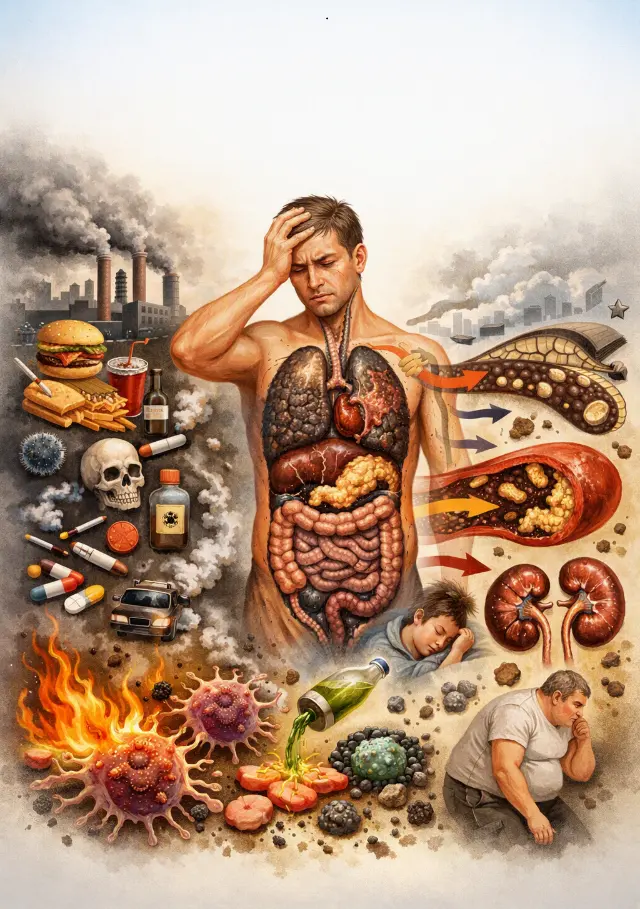
Foreword
The human cell is a marvel of biological organization, comparable to a living city in which every mechanism must function with extreme precision. It receives nutrients, transforms them into energy, communicates with its neighbors, and defends itself against external attacks. This ongoing ballet rests on complex mechanisms: membrane transport, enzymatic activity, energy metabolism, immune responses, and genetic regulation. But this fragile balance can be broken by the intrusion of foreign substances originating from modern diets or putrefactive intestinal flora. When the intestine becomes too permeable, undesirable molecules cross the digestive barrier and enter the bloodstream. The body tries to eliminate them through its excretory organs — liver, kidneys, lungs, skin — but when these capacities are exceeded, waste accumulates in tissues and eventually enters the heart of cells. This phenomenon, called accumulation, acts like grains of sand in an engine: it slows, disrupts, and ultimately breaks normal functioning.
Accumulation is not sudden; it develops slowly and silently. It explains the insidious progression of many chronic and degenerative diseases. Some cells die, others function inadequately or incorrectly, and still others suffer or become malignant. Thus, conditions as diverse as osteoarthritis, fibromyalgia, type 2 diabetes, Alzheimer's disease, and certain cancers find an explanation in this mechanism. Dr. Paul Carton, followed by Dr. Jean Seignalet, showed that modern diets — mutated cereal grains, dairy products, foods cooked at high temperatures — are the primary cause of this accumulation. Prevention rests on a hypotoxic diet rich in natural products, accompanied by mineral and vitamin supplements. Treatment aims to free cells of their waste to restore their vitality. Understanding accumulation means grasping the crucial importance of dietary practices in human health and opening the way to preventive and curative medicine founded on respect for biological laws.
How cells function
The human cell is a true biological factory, equipped with complex machinery that ensures life's continuity. At every moment, thousands of chemical and physical reactions take place within it, orchestrated by enzymes, proteins, and molecular messengers. The balance of these processes is essential: it guarantees energy production, synthesis of vital components, and harmonious communication with other cells.
Cellular functioning first relies on a supply of essential nutrients: water, minerals, trace elements, vitamins, carbohydrates, lipids, and proteins. These quality materials must be available in the correct quantities to nourish the cell and allow it to maintain its structures. Enzymes, true biological catalysts, then intervene to activate or regulate metabolic reactions. They are present in every cellular compartment and ensure the transformation of nutrients into energy or useful molecules.
Membranes play a central role: they allow substances to be transported, either passively through protein channels or actively through specific transporters. They also enable excretion of macromolecules by exocytosis and uptake of nutrients or signals by endocytosis. The cell does not live in isolation: it communicates at a distance through chemical messengers, receptors, and kinase cascades, but also by direct contact through gap junctions and surface molecules.
The extracellular matrix surrounding cells is more than a support: it participates in their nutrition, protection, and regulation. It forms a true network of communication and clearance. Inside the cell, energy metabolism is provided by glycolysis, the Krebs cycle, and oxidative phosphorylation, which transform nutrients into ATP, the essential energy currency. Anabolism enables construction of new molecules, while gene transcription and translation ensure production of proteins suited to needs.
The cell is also involved in immune and inflammatory responses, mobilizing lymphocytes, cytokines, and chemical mediators to defend the body. It produces and neutralizes free radicals, secretes hormones, releases neuropeptides, and regulates its own survival through mitosis or programmed apoptosis.
Thus, cellular functioning is a symphony of precise interactions. Any disturbance of these mechanisms — whether an enzymatic deficiency, excess free radicals, or intrusion of foreign molecules — can compromise vital balance. The accumulation theory is situated within this fragility: when waste builds up and disrupts these mechanisms, the cell loses its ability to function normally, opening the way to disease.
Waste originating from the intestine
The small intestine is an essential biological barrier: it filters useful nutrients and normally prevents undesirable molecules from crossing. But when this barrier is weakened by a modern diet rich in processed products, mutated cereal grains, or excess animal proteins, the mucosa becomes permeable. Enterocytes, specialized intestinal cells, are destroyed or separate, opening gaps through which foreign substances infiltrate. This phenomenon, called ‘intestinal hyperpermeability,’ is one of the entry points for accumulation.
The molecules crossing this barrier are varied. Some are immunogenic: antigenic peptides and superantigen proteins, capable of triggering a violent immune response followed by chronic inflammation. These reactions underlie many autoimmune diseases. Other molecules, however, have no immunogenic power but are no less harmful. They include poorly digested protein fragments, peptides that are too long or too short, certain lipids and carbohydrates, and bacterial DNA. Lipopolysaccharides from intestinal bacteria stimulate macrophages and sustain silent inflammation. Polyamines, produced by putrefactive flora or present in certain foods, disrupt cellular metabolism. Finally, Maillard products, generated by high-temperature cooking, cannot be broken down by digestive enzymes and circulate freely in the body.
Once in the bloodstream, these foreign molecules behave like intruders. They travel through the body and preferentially attach to certain tissues or cells according to their chemical structure. They can accumulate in the extracellular matrix, disrupt intercellular communication, or enter the cytoplasm and nucleus directly. Their presence is not innocuous: it consumes energy, blocks enzymes, generates free radicals, and disrupts biological signals.
Thus, the permeable intestine becomes a permanent source of waste that saturates the body. This mechanism explains why so many chronic diseases originate in the digestive system. Far from being a simple food passageway, the intestine is a vital boundary whose fragility opens the way to cellular accumulation. Understanding this central role connects digestive disorders with degenerative diseases and emphasizes the importance of a diet that respects human physiology.
The concept of accumulation
When dietary or bacterial waste crosses the intestinal barrier and enters the bloodstream, the body attempts to eliminate it through its natural excretory organs: liver, kidneys, lungs, and skin. But when incoming amounts exceed elimination capacities, these undesirable substances gradually build up in tissues. This phenomenon is called accumulation. It acts as a slow, silent saturation, comparable to limescale building up in a pipe or sand in an engine. Its consequences are multiple and affect both the extracellular environment and the inside of cells.
In the extracellular matrix, waste deposits in the ground substance and protein framework. It disrupts long-distance communication between cells, because many messengers pass through this environment. It also alters the support, nutrition, and regulation functions provided by the matrix. Some particles are phagocytosed by neutrophils and macrophages, consuming energy and releasing excess free radicals, worsening oxidative stress.
At cell membranes, foreign molecules can occupy the place of physiological ligands and trigger erroneous signals or block normal ones. They disrupt ion channel functioning and hinder direct communication between cells. In the cytoplasm and nucleus, intrusion by these molecules creates major risks: enzyme inhibition, blockage of nonenzymatic factors, and altered genetic regulation. Some studies have shown that synthetic polyamides or bacteriophage DNA consumed with food could bind to host DNA and alter gene expression.
The secondary consequences of this overload are clear: increased energy consumption, reduced energy production, disrupted cellular functioning, and excessive release of free radicals. The final outcome is cellular distress, death, or malignant transformation. Resistance to accumulation depends on each person's enzymatic makeup: some enzymes are more effective than others, and individuals are not equal in facing the assault of intestinal pollutants.
Thus, accumulation is a multifactorial disease process involving both hereditary factors (polymorphic genes, allozymes) and environmental factors (diet, bacterial flora). Three situations emerge:
- Enzymatic dysfunction + little waste = no disease.
- Effective enzymes + abundant waste = no disease.
- Enzymatic dysfunction + abundant waste = disease.
This reasoning explains why some people develop chronic diseases while others exposed to the same conditions remain healthy. Accumulation is therefore a universal mechanism, but its clinical expression varies with individual constitution and lifestyle.
The fate of cells burdened by accumulation
Progressive accumulation in cells does not lead to a single type of dysfunction but to a variety of possible fates. Consequences differ according to the nature of foreign molecules, their affinity for certain tissues, the enzymes affected, and each cell's capacity for resistance. This process explains the diversity of chronic and degenerative diseases observed in medical practice.
The first possibility is cell death. When waste saturates vital mechanisms, the cell can no longer maintain its metabolism and dies. This phenomenon is observed in Alzheimer's disease, in which neurons gradually die, or in advanced Parkinson's disease. Type 2 diabetes in its final stages also illustrates this outcome, with destruction of pancreatic beta cells.
The second possibility is insufficient function. The cell survives but no longer fulfills its role properly. In early Parkinson's disease, dopaminergic neurons produce too little dopamine. In osteoporosis, osteoblasts manufacture insufficient bone tissue, weakening the skeletal structure.
The third outcome is erroneous function. The cell acts incorrectly, producing pathological effects. This occurs in hypercholesterolemia, where liver cells disrupt lipid regulation. Osteoarthritis and gout also illustrate this mechanism, with disturbances in joint and uric acid metabolism. In schizophrenia, some nerve cells transmit aberrant signals, causing psychiatric disturbances.
The fourth possibility is cellular distress. The cell remains alive but expresses permanent distress. This manifests in diseases such as fibromyalgia, in which muscle and nerve cells generate widespread pain, or spasmophilia, marked by neuromuscular hyperexcitability. Endogenous depression also illustrates this distress, with neurons unable to regulate neurotransmitters properly.
Finally, the fifth outcome is malignant transformation. Some cells, saturated with waste and genetically dysregulated, become cancerous. This mechanism underlies certain leukemias and common cancers such as breast, prostate, or colon cancer.
Thus, cells burdened by accumulation have multiple possible fates: death, insufficiency, dysregulation, distress, or malignancy. This spectrum explains the variety of chronic diseases and their slow, insidious, often irreversible progression. Accumulation is therefore a universal framework for interpreting modern diseases, linking digestive disorders to neurological, metabolic, and cancerous conditions.
Preventing and treating accumulation
If cellular accumulation is a direct consequence of an unsuitable modern diet, prevention and treatment rely above all on nutritional reform. Mutated cereal grains, dairy products, and foods cooked at high temperatures introduce foreign molecules into the body that digestive enzymes cannot break down. These fragments then circulate in the blood, saturate tissues, and disrupt cellular metabolism. To interrupt this vicious circle, it is necessary to drastically reduce intake of harmful substances and favor a diet that respects human physiology.
The so-called hypotoxic diet is the cornerstone of this approach. It excludes modern grains and dairy products while favoring raw foods rich in vitamins and natural enzymes. Organic, first cold-pressed oils supply essential fatty acids that support membrane fluidity and cellular communication. Targeted supplementation is added to this nutritional foundation: magnesium to regulate neuromuscular excitability, trace elements and vitamins to support enzymatic reactions, and lactic acid cultures to restore balanced intestinal flora.
When intake of harmful molecules decreases, the body's elimination capacities regain the upper hand. The excretory organs — liver, kidneys, lungs, skin — can then gradually rid tissues of accumulated waste. This process of clearing cellular accumulation produces clinical improvement: pain diminishes, energy returns, and metabolic functions regain balance. In some cases, a cure is possible; in others, disease progression is slowed or stabilized.
To accelerate this clearance, some practitioners recommend isotonic Quinton, seawater made isotonic whose composition resembles the fluids of the extracellular matrix. This product acts as a true tissue rinse, promoting waste elimination and supporting cellular regeneration.
Thus, prevention and treatment of accumulation rely on suitable dietary and biological practices rather than intensive medications or invasive interventions. This approach restores the body's natural capacity for self-regulation and opens the way to preventive medicine centered on respect for biological laws. Far from being simply a theory, accumulation becomes a practical key to understanding, preventing, and treating the chronic diseases of our time.
Conclusion
The accumulation theory offers a powerful interpretive framework for understanding the chronic and degenerative diseases affecting our era. It directly connects modern diets, weakening of the intestinal barrier, and buildup of waste in cells. This mechanism explains why conditions as diverse as osteoarthritis, fibromyalgia, type 2 diabetes, Alzheimer's disease, and certain cancers share a common origin: progressive saturation of tissues and cells by foreign molecules.
Accumulation is not an inevitable fate. It results from unsuitable lifestyle and diet, but it can be prevented and sometimes reversed. By adopting a hypotoxic diet, favoring raw and organic foods, and supporting the body with minerals, vitamins, and probiotics, it is possible to reduce toxin intake and restore natural elimination capacities. Clearing cellular accumulation then becomes a clinical reality, reflected in improved symptoms, stabilized diseases, and sometimes a cure.
This nutritional and biological approach goes beyond theory: it draws on clinical observations, tangible results, and sound physiological reasoning. It restores the fundamental dimension of preventive and curative medicine: respecting the body's biological laws. The accumulation theory reminds us that health is not merely the absence of disease but the dynamic balance between intake, elimination, and regeneration.
In conclusion, understanding and applying this theory means offering every individual the possibility of regaining control of their health, preventing premature aging, and reducing the risk of serious diseases. It also means placing nutrition back at the heart of medicine as a tool for prevention and healing.