
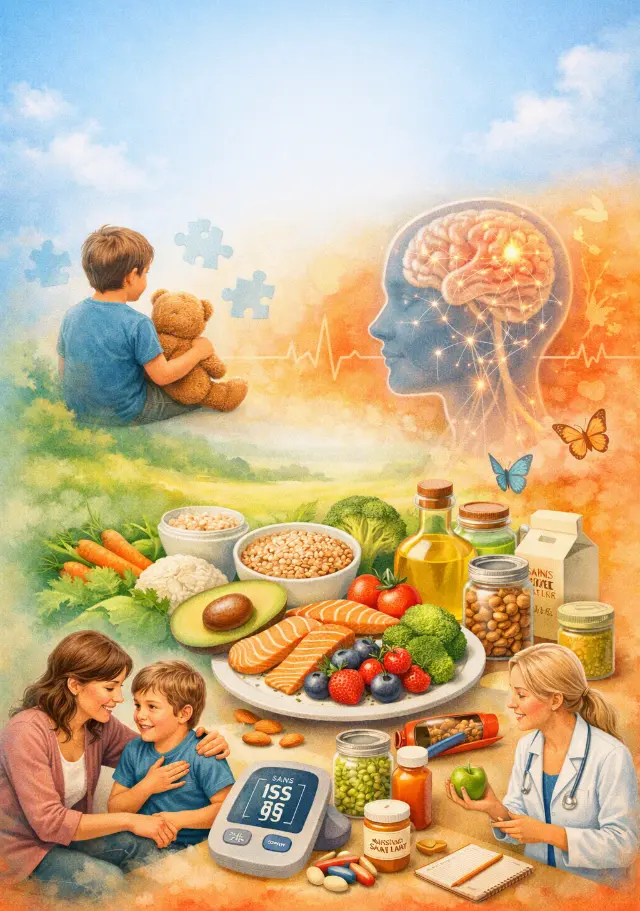
Foreword
Autism is a complex condition of brain development, appearing early, often before age three, and producing multiple problems affecting socialisation, language and behaviour. Its frequency has increased considerably over recent decades, making it a major public health issue. Families facing this reality often feel helpless in the absence of definitive solutions and seek avenues beyond conventional educational and therapeutic approaches.
In this context, the concept of accumulation disorders brings a new and stimulating interpretation. It suggests that certain brain cells — particularly neurons and astrocytes — can become saturated with dietary and bacterial molecules from an excessively permeable small intestine. This accumulation disrupts their functioning and contributes to observed problems. Long considered a simple digestive organ, the intestine now appears as a decisive interface between modern food and brain health.
This booklet offers a clear exploration of this hypothesis, highlighting contemporary food's role, often rich in processed products, mutated cereals and oxidised fats, and presenting encouraging hypotoxic diet results. Developed and validated by several clinicians, this nutritional approach aims to reduce aggressive molecule intake and restore a healthy intestinal barrier, an essential condition for limiting cerebral accumulation.
Family Clinic's mission is to offer families practical, scientifically grounded and educationally accessible tools. We do not claim to provide a miracle solution, but propose a coherent framework based on clinical observations and biological data, offering hope of tangible improvement in quality of life for autistic children and their loved ones.
This work forms part of a broader approach: place nutrition at the heart of prevention and therapeutic support. Like other chronic conditions, autism should not be perceived as an immutable inevitability, but as a condition where environment, food and lifestyle play a decisive role.
This foreword establishes the framework: understand autism through accumulation, open the way to an innovative nutritional approach and remember that every family can become an active participant in its own care journey.
Clinical presentation and increasing frequency
Autism is a condition of brain development manifesting very early, generally before age three. Initial signs are often subtle: a child not responding to their name, avoiding eye contact, showing no interest in group games or experiencing delayed language acquisition. Progressively, these signs become more evident and organise around three main areas: socialisation difficulties, communication difficulties and repetitive or stereotyped behaviours.
- Socially, an autistic child is characterised by marked isolation. They may seem indifferent to others, reject physical contact or retreat into an inner world difficult to share. Peer interactions are limited, and family relationships may be profoundly affected by this withdrawal.
- Language difficulties are major. Some children do not speak at all; others develop atypical language, with echolalia (automatic repetition of words or phrases), pronoun reversals or very literal word use. Non-verbal communication is also impaired: absence of gestures, facial expressions or pointing, reinforcing the impression of a closed inner world.
- Repetitive and stereotyped behaviours constitute another central aspect. A child may line up objects, repeat the same movements, rock or show extreme intolerance of change. The slightest disruption of routines may provoke anger or anxiety attacks.
- Intellectual delay varies. Some children have mild forms, with normal or above-normal IQ but persistent social difficulties. Others have severe deficits, making future independence very uncertain. This heterogeneity makes prognosis difficult and complicates care.
Since the 1990s, autism frequency has surged in Western countries. In the United States, figures show a fivefold increase in diagnosed children. Europe shows a similar trend, with constantly increasing recorded cases. This rapid progression cannot be explained through a purely genetic cause. It requires considering environmental factors linked to food, pollutants, lifestyle changes and evolving medical practices.
Family Clinic reminds us that understanding problems' origins is essential for action. Autism should not be perceived as an immutable inevitability, but as a condition where environment and food play a decisive role.
This chapter highlights clinical manifestations' diversity, concerning epidemiological developments and the need to broaden perspectives beyond genetic hypotheses alone. It thus prepares the ground for introducing accumulation, developed in the next chapter.
Accumulation hypotheses and the intestine's role
For several decades, researchers have observed persistent digestive abnormalities in autistic children. Long considered secondary, these problems now appear central to understanding the condition. Clinical studies reveal small-intestinal hyperpermeability, digestive mucosal fragility and dietary peptides in urine. These data suggest that foreign molecules cross the intestinal barrier and circulate in the blood, subsequently reaching the brain.
Conventional hypotheses — food allergy, autoimmunity, opioid peptides derived from gluten or casein — have partly explained certain symptoms, but do not account for the entire clinical picture. The cerebral accumulation hypothesis appears more coherent: neurons and astrocytes would be saturated with dietary and bacterial waste, disrupting electrical and chemical functioning. This saturation alters neuronal circuits, responsible for communication problems, stereotyped behaviours and cognitive difficulties.
Two major arguments strengthen this theory:
- Onset often occurs after introducing flours into the diet, suggesting a pathogenic role for modern cereals, mutated and cooked at high temperatures. Rich in complex molecules, these products are difficult to digest and favour intestinal permeability.
- Autism frequency has increased sharply over the last fifty years alongside other accumulation disorders such as type 2 diabetes, atherosclerosis or certain neurodegenerative diseases. This concurrence suggests a shared mechanism: progressive accumulation of dietary and metabolic waste in tissues.
The intestine thus appears a preferred entry point for harmful molecules. When the intestinal barrier is altered, protein fragments, bacterial toxins and dietary residues cross the mucosa and enter the bloodstream. The highly sensitive brain then becomes these intruders' target. Glial cells responsible for protecting and nourishing neurons become saturated and unable to fulfil their role.
Family Clinic stresses the importance of restoring a healthy intestinal barrier. This step is key to reducing cerebral accumulation and allowing neuronal circuits to regain better functionality. By eliminating the most aggressive products (mutated cereals, industrial dairy products, oxidised fats), hypotoxic nutrition helps decrease the toxic burden and strengthen the digestive mucosa.
This chapter highlights the intestine's central role in the genesis of autistic difficulties. It demonstrates that autism cannot be understood solely as a genetic or neurological abnormality, but as a systemic condition where food and environment play a decisive role.
Results of the hypotoxic diet and conclusion
Clinical observations in recent years bring particularly encouraging insight into the hypotoxic diet's impact in supporting autistic children. Several practitioners, including Dr Éric Menat, followed cohorts of children using this nutritional approach. Although preliminary, results are sufficiently significant to justify particular attention.
In a group of 19 autistic children, 14 showed clear, sometimes spectacular improvement after adopting the hypotoxic diet. Benefits appeared rapidly, often from the first month: fewer digestive problems, better sleep, reduced stereotyped behaviours and, above all, better social interaction. Some parents reported unexpected progress, such as new words appearing, increased curiosity about surroundings or fewer anger episodes.
A striking element is that autism's duration does not appear to limit dietary effectiveness. Children diagnosed several years earlier showed improvements comparable to those receiving earlier care. This suggests that cerebral accumulation, although established, remains reversible to some extent, provided harmful molecule intake is reduced and a healthy intestinal barrier restored.
The hypotoxic diet acts on several mechanisms:
- It reduces exposure to mutated cereals and industrial dairy products, often implicated in intestinal hyperpermeability.
- It favours natural, minimally processed foods rich in fibre and protective micronutrients.
- It reduces oxidative and inflammatory burdens, allowing brain cells to function in a more stable environment.
These results should not be interpreted as a definitive cure for autism. The hypotoxic diet does not replace educational, teaching and therapeutic approaches, but constitutes a valuable complement. It offers families a concrete, accessible and safe strategy that may improve everyday quality of life.
Family Clinic emphasises that hypotoxic nutrition must be incorporated into comprehensive care. It accompanies medical follow-up, educational support and psychological support. The goal is not to promise a miracle solution, but propose a realistic path to reduce symptoms and promote autistic children's flourishing.
This chapter illustrates the hypotoxic diet's clinical relevance: it demonstrates that food, often neglected in conventional protocols, can become a major therapeutic tool. Families adopting this approach can hope for tangible, rapid and lasting improvements, strengthening confidence and ability to support their children.
Conclusion
Autism is a complex, multifactorial condition profoundly destabilising for families. Care has long relied on educational, behavioural and therapeutic approaches that, although indispensable, do not always suffice to durably improve affected children's quality of life. Its surging frequency over recent decades requires rethinking explanatory models and broadening intervention strategies.
As developed in this booklet, the accumulation hypothesis offers a new, coherent interpretation. It highlights the intestine and modern food's central role in problems' genesis. Far from reducing autism to a simple genetic or neurological abnormality, this approach considers it systemic, with environment and nutrition playing a decisive role.
Clinical results obtained through the hypotoxic diet are encouraging: improved digestive problems, reduced stereotyped behaviours, progress in communication and socialisation. Although requiring larger studies, these observations confirm that nutrition can act on accumulation mechanisms and help restore better cerebral functionality.
It is essential to remember that this approach is neither a miracle solution nor a substitute for conventional care. It must be incorporated into a comprehensive strategy combining educational support, psychological support and medical follow-up. But it represents a valuable, accessible and safe complement restoring hope to families.
Family Clinic commits to offering personalised support based on education and hypotoxic nutrition. Our mission is to provide practical, scientifically grounded tools adapted to families' everyday realities. We believe every parent can become an active participant in their child's health by making healthier food choices and understanding mechanisms underlying difficulties.
This booklet aims to open rather than close debate. It invites families, practitioners and researchers to explore new avenues together, compare hypotheses and enrich practices. Autism should not be perceived as an immutable inevitability, but as a condition where opportunities for progress exist, provided all available resources are mobilised.
In conclusion, autism is complex, but concrete avenues for action exist. By understanding accumulation's role and adopting hypotoxic nutrition, families can hope for significant improvement. This path requires patience, perseverance and willingness to change, but opens the way to better quality of life for children and their loved ones.