
Foreword
Autoimmune diseases constitute a major field of modern medicine, marked by constant growth and increasing complexity. They include conditions such as rheumatoid arthritis, multiple sclerosis, systemic lupus erythematosus, type 1 diabetes and autoimmune thyroiditis. Their common feature is immune-system dysregulation: instead of protecting the body against external threats, it turns against its own tissues and destroys them.
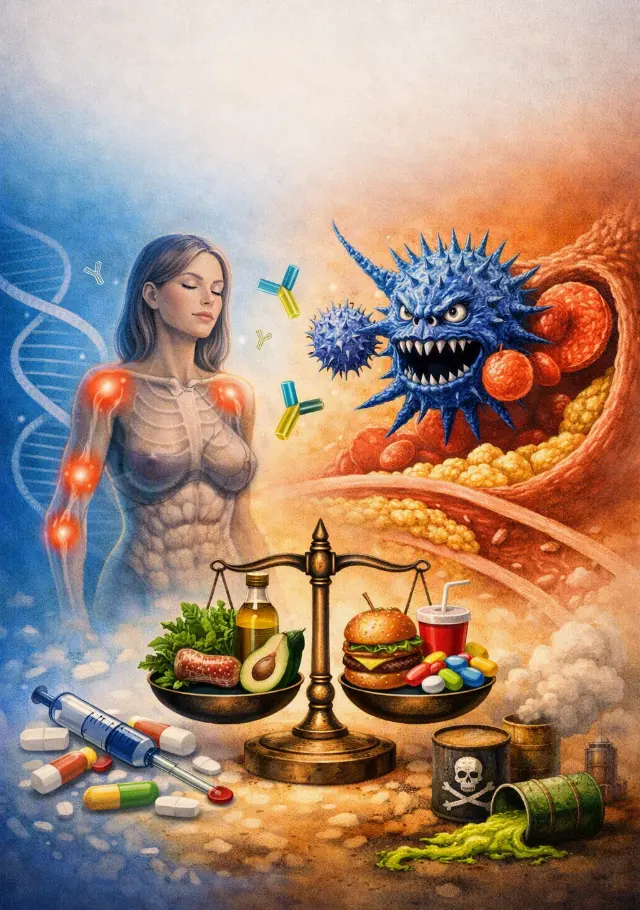
Conventional medicine explains these diseases through genetic abnormalities, environmental factors or triggering viral infections. But from the perspective of accumulation disorders, they principally reflect chronic metabolic overload. Dietary and bacterial waste saturates enzymes and disrupts immune signals. The disoriented defence system eventually attacks the body's cells. Self-aggression is therefore not an inevitability written in genes, but the consequence of saturated and weakened underlying conditions.
The ancestral or hypotoxic diet appears a promising response. By excluding dairy products, cooked fats and refined sugars, and favouring raw virgin oils, fresh fruit and vegetables and gentle cooking, it eases enzymatic work and restores immune coherence. Clinical observations show that certain autoimmune diseases improve rapidly on a hypotoxic diet: joint pain decreases, neurological flare-ups become more widely spaced and skin inflammation lessens.
This Family Clinic booklet offers a new interpretation: understand autoimmune diseases as manifestations of accumulation and show that nutritional reform can reverse or stabilise them. It delivers a message of hope: even with serious conditions often considered incurable, the body can regain balance when food respects its enzymatic capacities.
Rheumatoid arthritis
Rheumatoid arthritis is one of the most widespread and disabling autoimmune diseases. It is characterised by chronic joint inflammation causing pain, swelling, morning stiffness and progressive deformities. Patients suffer intense fatigue, loss of mobility and sometimes systemic complications affecting the heart, lungs or eyes.
Conventional medicine explains this condition through immune dysregulation: the defence system attacks the synovium, causing persistent inflammation and cartilage destruction. Genetic and environmental factors are involved, but the exact cause remains unknown.
From the perspective of accumulation disorders, rheumatoid arthritis reflects chronic metabolic overload. Dietary and bacterial waste saturates enzymes and disrupts immune signals. Unable to regenerate properly, joints become the site of a self-aggressive reaction. Inflammation is therefore not an inevitability written in genes, but the consequence of saturated and weakened underlying conditions.
The ancestral or hypotoxic diet offers a promising response. By excluding dairy products, cooked fats and refined sugars, and favouring raw virgin oils, fresh fruit and vegetables and gentle cooking, it eases enzymatic work and restores immune coherence. Clinical observations show that rheumatoid arthritis improves rapidly on a hypotoxic diet: pain decreases, joints become less swollen, mobility returns and flare-ups become less frequent. In some cases, disease enters lasting remission.
This improvement confirms that rheumatoid arthritis is indeed an accumulation disease: when food respects human enzymatic capacities, joints regain balance and inflammation subsides. Modern nutrition, too rich in cooked fats and refined sugars, imposes excessive work on enzymes and weakens the synovium. Returning to ancestral nutrition removes this overload and restores harmonious joint function.
Rheumatoid arthritis is therefore not inevitable. It reminds us of joints' fragility in the face of accumulation, but also shows that nutrition can be a powerful weapon for restoring joint health and giving patients hope.
Multiple sclerosis
Multiple sclerosis (MS) is an autoimmune disease of the central nervous system characterised by progressive destruction of myelin, the protective sheath surrounding nerve fibres. Symptoms vary: visual problems, muscle weakness, numbness, balance problems, intense fatigue and sometimes cognitive difficulties. Its course is unpredictable, alternating flare-ups and remissions, with a risk of progressive disability.
Conventional medicine explains MS through immune dysregulation: lymphocytes attack myelin, causing inflammation and demyelination. Genetic, viral and environmental factors are involved, but the exact cause remains unknown. Current treatments aim to reduce flare-up frequency and slow progression, but cannot cure.
From the perspective of accumulation disorders, MS reflects chronic metabolic overload. Dietary and bacterial waste saturates enzymes and disrupts immune signals. The disoriented defence system eventually attacks myelin. Self-aggression is therefore not an inevitability written in genes, but the consequence of saturated and weakened underlying conditions.
The ancestral or hypotoxic diet offers a promising response. By excluding dairy products, cooked fats and refined sugars, and favouring raw virgin oils, fresh fruit and vegetables and gentle cooking, it eases enzymatic work and restores immune coherence. Clinical observations show that MS improves on a hypotoxic diet: flare-ups become less frequent, symptoms lessen and some patients regain better mobility and increased energy. In some cases, disease enters lasting remission.
This improvement confirms that multiple sclerosis is indeed an accumulation disease: when food respects human enzymatic capacities, the nervous system regains balance and inflammation subsides. Modern nutrition, too rich in cooked fats and refined sugars, imposes excessive work on enzymes and weakens myelin. Returning to ancestral nutrition removes this overload and restores harmonious neurological function.
Multiple sclerosis is therefore not inevitable. It reminds us of the nervous system's fragility in the face of accumulation, but also shows that nutrition can be a powerful weapon for restoring neurological health and giving patients hope.
Systemic lupus erythematosus
Systemic lupus erythematosus (SLE) is a systemic autoimmune disease illustrating the complexity of dysregulated immune reactions. It is characterised by multi-organ involvement: the skin, joints, kidneys, heart, lungs and nervous system may be affected. Symptoms vary: chronic fatigue, joint pain, a “butterfly” facial rash, fever, photosensitivity and sometimes severe kidney involvement. Its course is unpredictable, alternating flare-ups and remissions, with a risk of serious complications.
Conventional medicine explains lupus through immune dysregulation: the defence system produces autoantibodies that attack cell nuclei, causing widespread inflammation. Genetic, hormonal and environmental factors are involved, but the exact cause remains unknown. Current treatments rely on corticosteroids and immunosuppressants, which reduce inflammation but expose patients to substantial side effects.
From the perspective of accumulation disorders, lupus reflects chronic metabolic overload. Dietary and bacterial waste saturates enzymes and disrupts immune signals. The disoriented defence system eventually attacks healthy tissues. Self-aggression is therefore not an inevitability written in genes, but the consequence of saturated and weakened underlying conditions.
The ancestral or hypotoxic diet offers a promising response. By excluding dairy products, cooked fats and refined sugars, and favouring raw virgin oils, fresh fruit and vegetables and gentle cooking, it eases enzymatic work and restores immune coherence. Clinical observations show that lupus improves on a hypotoxic diet: flare-ups become less frequent, joint pain lessens, skin rashes decrease and fatigue reduces. In some cases, disease enters lasting remission.
This improvement confirms that lupus is indeed an accumulation disease: when food respects human enzymatic capacities, tissues regain balance and inflammation subsides. Modern nutrition, too rich in cooked fats and refined sugars, imposes excessive work on enzymes and weakens immunity. Returning to ancestral nutrition removes this overload and restores harmonious immune function.
Lupus is therefore not inevitable. It reminds us of the immune system's fragility in the face of accumulation, but also shows that nutrition can be a powerful weapon for restoring overall health and giving patients hope.
Type 1 diabetes
Type 1 diabetes is an autoimmune disease characterised by destruction of pancreatic beta cells responsible for insulin secretion. Deprived of this essential hormone, the body can no longer regulate blood glucose, causing chronic hyperglycaemia. Symptoms appear suddenly: intense thirst, polyuria, rapid weight loss, extreme fatigue. Without treatment, disease progresses to diabetic ketoacidosis, a serious and potentially fatal complication.
Conventional medicine explains type 1 diabetes through an autoimmune reaction: the immune system attacks beta cells under the influence of genetic and environmental factors. Treatments rely on insulin therapy, indispensable to sustaining life, but cannot restore pancreatic function.
From the perspective of accumulation disorders, type 1 diabetes reflects chronic metabolic overload. Dietary and bacterial waste saturates enzymes and disrupts immune signals. The disoriented defence system eventually attacks beta cells. Self-aggression is therefore not an inevitability written in genes, but the consequence of saturated and weakened underlying conditions.
The ancestral or hypotoxic diet offers a complementary response. By excluding dairy products, cooked fats and refined sugars, and favouring raw virgin oils, fresh fruit and vegetables and gentle cooking, it eases enzymatic work and restores immune coherence. Clinical observations show that some patients with type 1 diabetes experience improved blood glucose balance on a hypotoxic diet: insulin requirements decrease, hypoglycaemia becomes less frequent and quality of life improves.
This improvement confirms that type 1 diabetes is indeed an accumulation disease: when food respects human enzymatic capacities, the immune system regains balance and inflammation lessens. Modern nutrition, too rich in cooked fats and refined sugars, imposes excessive work on enzymes and weakens the pancreas. Returning to ancestral nutrition removes this overload and restores more harmonious blood glucose regulation.
Type 1 diabetes is therefore more than genetic inevitability. It reminds us of the pancreas's fragility in the face of accumulation, but also shows that nutrition can be a powerful weapon for improving metabolic health and giving patients hope.
Autoimmune thyroiditis (Hashimoto's, Graves')
Autoimmune thyroid diseases principally include two conditions: Hashimoto's thyroiditis and Graves' disease. They illustrate the endocrine system's fragility in the face of immune self-aggression.
Hashimoto's thyroiditis is characterised by progressive destruction of the thyroid gland, causing hypothyroidism. Symptoms include chronic fatigue, sensitivity to cold, weight gain, constipation, dry skin and concentration problems. The disease progresses slowly but often leads to thyroid insufficiency requiring replacement treatment.
Graves' disease, conversely, causes hyperthyroidism through excessive gland stimulation. Patients experience rapid weight loss, nervousness, palpitations, trembling, excessive sweating and sometimes exophthalmos (protruding eyes). Its course can be severe, with cardiac or bone complications.
Conventional medicine explains these conditions through immune dysregulation: the defence system produces autoantibodies that destroy or stimulate the thyroid. Treatments rely on replacement hormones, synthetic antithyroid drugs or sometimes surgery.
From the perspective of accumulation disorders, these diseases reflect chronic metabolic overload. Dietary and bacterial waste saturates enzymes and disrupts immune signals. The disoriented defence system eventually attacks or stimulates the thyroid. Self-aggression is therefore not genetic inevitability, but the consequence of saturated and weakened underlying conditions.
The ancestral or hypotoxic diet offers a complementary response. By excluding dairy products, cooked fats and refined sugars, and favouring raw virgin oils, fresh fruit and vegetables and gentle cooking, it eases enzymatic work and restores immune coherence. Clinical observations show that autoimmune thyroid diseases improve on a hypotoxic diet: symptoms lessen, treatment requirements decrease and quality of life improves.
This improvement confirms that autoimmune thyroid diseases are indeed accumulation diseases: when food respects human enzymatic capacities, the thyroid regains balance and inflammation subsides. Modern nutrition, too rich in cooked fats and refined sugars, imposes excessive work on enzymes and weakens the endocrine system. Returning to ancestral nutrition removes this overload and restores harmonious thyroid function.
Hashimoto's and Graves' diseases are therefore not inevitable. They remind us of the thyroid's fragility in the face of accumulation, but also show that nutrition can be a powerful weapon for restoring endocrine health and giving patients hope.