
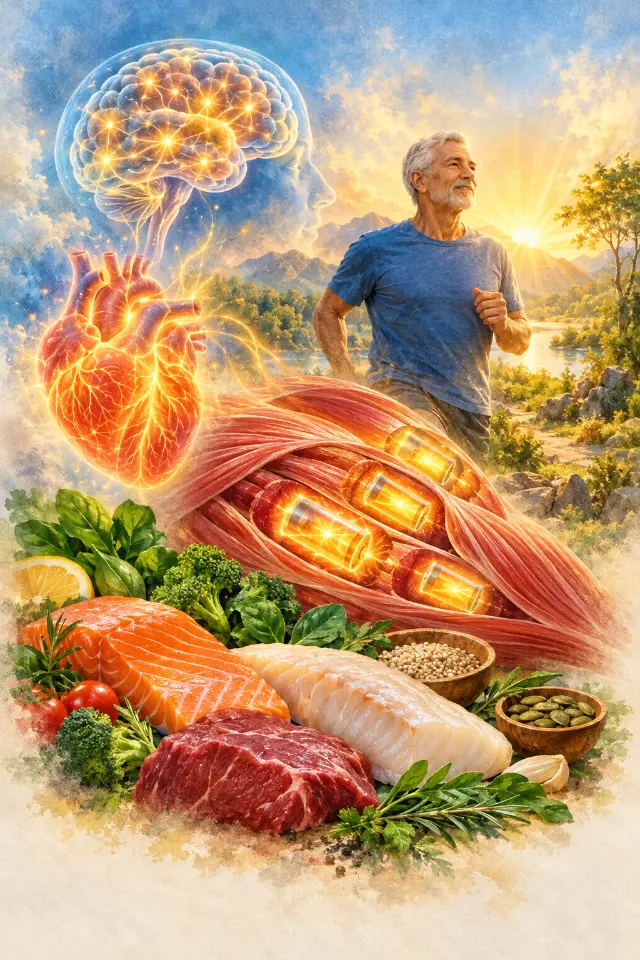
When the word “creatine” comes up, many people immediately think of bodybuilders, gyms and the pursuit of physical performance. This image, widely conveyed for several decades, long limited interest in this substance, even though it is naturally present in the human body.
Today, researchers are increasingly interested in creatine in a very different context: that of aging, muscle preservation and the maintenance of cognitive abilities. This advance in scientific knowledge is particularly interesting for people over fifty.
Creatine is not an artificial product invented for athletes. It is a molecule naturally made by our body from several amino acids. It is also supplied by certain foods, notably meat, fish and seafood. Once produced or absorbed, it is stored mainly in the muscles, but also in the brain, the heart and several other tissues.
To understand why it matters, we first need to look at how our body produces its energy. Every cell in the body needs energy to do its work. The muscles need energy to contract. The brain needs energy to process information. The heart needs energy to beat continuously.
Even when we are at rest, billions of biological reactions are continuously taking place in our body. Creatine is involved precisely in this energy system.
It can be compared to a backup battery that gives cells quick access to an energy reserve when they need it. When an effort is made, even a brief one, creatine helps maintain the energy availability needed for cells to function.
This function explains why it was first studied in the field of sport. But over time, researchers realized that this energy-related action could also be of interest in the context of aging.
With age, several natural phenomena gradually appear. Muscle mass decreases, strength slowly declines, recovery sometimes becomes more difficult and the capacity for intense effort may diminish. At the same time, certain cognitive functions may also become more vulnerable to fatigue. These changes are normal, but they can be influenced by lifestyle. Physical activity remains the main way to counter these transformations.
However, researchers are also seeking to identify nutrients able to support this effort to preserve function. Creatine is among the most studied candidates. Its value is particularly evident at the muscle level.
The muscles are one of the body’s largest reservoirs of creatine. When reserves are adequate, muscle is better able to respond to certain efforts.
In people who do suitable strength training, creatine seems to promote the mechanisms involved in maintaining or developing strength. This characteristic has caught the attention of specialists in aging.
Indeed, age-related muscle loss is one of the main causes of loss of independence. A person who keeps their muscle strength generally remains able to walk more, get up more easily, carry loads and stay independent for longer. Preserving the muscles therefore means preserving freedom of movement.
But the story of creatine does not stop at the muscles. The brain, too, consumes a considerable amount of energy. Although it accounts for only a small proportion of body weight, it uses a large share of the energy the body produces. Every thought, every memory, every bit of learning and every decision requires significant energy resources.
Researchers have observed that the brain also uses creatine in some of its energy mechanisms. This discovery opened a new field of research devoted to the links between creatine and brain function.
Several studies suggest that this molecule could be particularly valuable in situations where the brain’s energy needs increase. Mental fatigue, lack of sleep, periods of intense intellectual effort and certain particular physiological situations are currently the subject of in-depth studies.
Even though many questions remain to be explored, scientific interest in this area keeps growing. Vegetarians and vegans are a particularly well-studied population.
Because dietary creatine comes mainly from animal products, their reserves may naturally be lower. This situation has made it easier for researchers to observe certain biological differences and to assess the impact of supplemental intake in different contexts.
The safety of creatine has also been extensively analyzed. Contrary to some common misconceptions, it is among the most studied nutritional supplements in the world. The scientific data accumulated over several decades now allow a better understanding of how it works and where it can be applied.
However, as with any nutritional approach, its use should always fit within an overall health strategy. No substance, however promising, can replace the foundations of successful aging.
Creatine does not replace physical activity. It does not replace sleep. It does not replace a balanced diet. It does not replace an active and socially rich life.
These pillars remain the priority. Longevity never rests on a single molecule. It results from the interaction of many favorable factors that reinforce one another. For this reason, creatine should be considered a complementary tool and not a miracle solution.
Its potential value is particularly relevant in an approach aimed at preserving muscle mass, supporting exercise capacity and maintaining the functions essential to independence for as long as possible.
Healthy aging is above all about keeping your ability to act. Being able to walk. Being able to think. Being able to learn. Being able to take part in family and social life. Being able to remain independent. All these functions depend on a body able to produce and use its energy efficiently.
In this respect, creatine now appears as one of the most interesting elements of modern longevity-related nutrition. It perfectly illustrates a new vision of aging: not trying to stop time, but helping the body and the brain keep their abilities for as long as possible.
Family Clinic advice
After fifty, the priority is not to pursue athletic performance but to preserve muscle function and independence. Combine regular physical activity, sufficient intake of high-quality protein and a balanced diet. The muscles are one of the most precious reserves of health for the decades to come.