
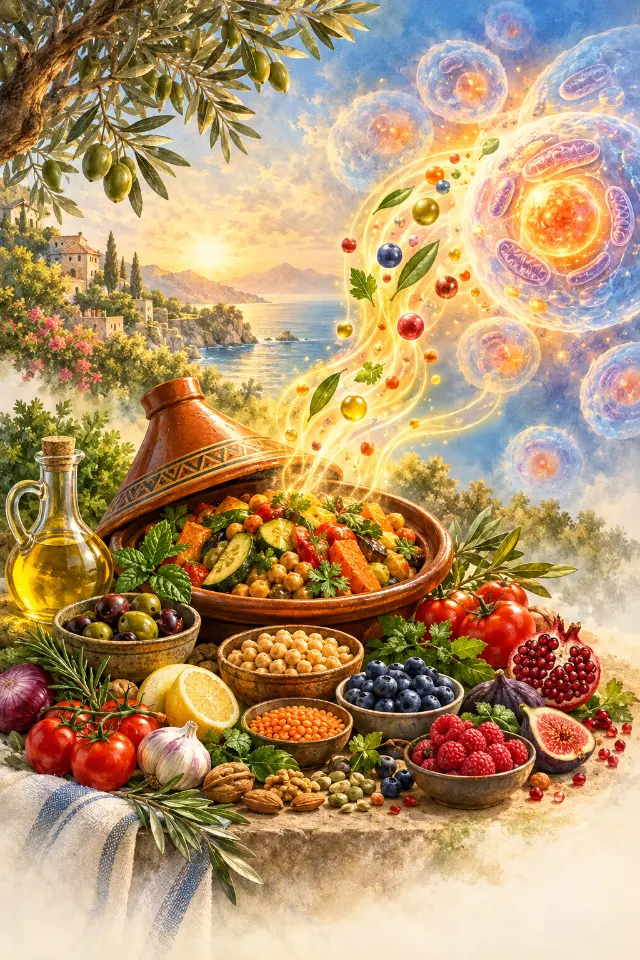
Human beings have always searched for the secret of longevity. Some civilizations sought it in medicinal plants, others in mysterious elixirs or particular practices. Yet one of the most important answers probably lies in something we do several times a day: eating.
Food is much more than a simple way to satisfy hunger. Every food we eat provides biological information to the body. Every meal influences how our cells function, the quality of our tissues, the condition of our arteries, the work of the brain, hormone activity and the mechanisms of inflammation. In this sense, eating is not just an act of nutrition. It is an act of biological programming.
Over the decades, researchers have observed that certain eating habits are associated with better health and greater longevity. Conversely, others gradually encourage the onset of chronic diseases that accelerate aging. This observation has led to an essential conclusion: there is probably no miracle food, but there are dietary patterns that can profoundly influence our health trajectory.
Aging is naturally accompanied by a gradual accumulation of cellular damage. Every breath, every physical effort and every metabolic reaction produces reactive molecules called free radicals. These molecules are part of the body’s normal functioning. However, when they become too abundant, they can contribute to damaging certain cellular structures.
Fortunately, nature has provided defense mechanisms. Fruits, vegetables, aromatic herbs, spices and many natural foods contain protective substances called antioxidants. These compounds take part in the body’s natural protection and repair systems.
This is why people who regularly eat a variety of plant foods often have a better health profile as they age. The colors found in nature are often an excellent indicator of nutritional richness.
- Green vegetables provide many minerals and protective compounds.
- Orange vegetables are rich in carotenoids.
- Red fruits contain particularly valuable polyphenols.
- Purple vegetables also contain pigments with remarkable properties.
The more naturally colorful the plate, the more likely it is to provide a wide range of beneficial substances.
This diversity plays an essential role. No single food contains all the necessary nutrients on its own. Health depends more on complementarity than on perfection. Eating different plant foods over the course of the week multiplies the sources of vitamins, minerals and protective compounds.
Vegetables thus hold a central place in the anti-aging diet. They provide relatively few calories but great nutritional richness. Their fiber content also supports the proper functioning of the digestive system.
And gut health today influences many aspects of human physiology. The gut microbiota, made up of billions of microorganisms living in the digestive tract, takes part in digestion, immunity and several metabolic mechanisms.
Dietary fiber is one of its main fuels. By nourishing this microbiota, vegetables, fruits and legumes contribute indirectly to maintaining a favorable biological terrain.
Protein also plays a fundamental role. With age, maintaining muscle mass becomes a priority. To renew muscle tissue, the body needs an adequate supply of high-quality protein. The most valuable sources include in particular: fish; eggs; legumes; chickpeas; lentils; some poultry; nuts; seeds. These foods help maintain the muscles but also take part in many cellular repair processes.
Good fats are another pillar of the longevity diet. For years, dietary fats were unfairly blamed for every ill. Today, scientists know that some of them are essential to health. Extra virgin olive oil, oily fish, walnuts, almonds and certain seeds provide fatty acids that contribute to cardiovascular protection and proper brain function.
Populations that traditionally enjoy a Mediterranean-style diet often show particularly favorable profiles in terms of health and aging. This dietary pattern rests mainly on: vegetables; fruits; legumes; fish; olive oil; aromatic herbs; minimally processed foods. It is not a strict diet but rather a sustainable way of eating. At the other extreme, certain modern products pose more problems.
Ultra-processed foods now hold a large place in many people’s eating habits. They are often high in added sugars, refined flours, additives and calories of little nutritional value. Eating them frequently generally leads to excessive energy intake while providing relatively few protective nutrients.
This situation gradually contributes to several imbalances: weight gain; insulin resistance; chronic inflammation; disruption of the gut microbiota; lower overall nutritional quality.
Excess sugar deserves particular attention. Glucose is an essential source of energy. The problem is therefore not the sugar naturally present in fruit or certain whole foods. The difficulty arises when intake becomes excessive and repeated through sugary drinks, industrial pastries, candy and many processed products. Over the long term, this overload can promote metabolic changes that accelerate certain aspects of aging.
Hydration is also part of the equation. With age, the sensation of thirst can diminish. Yet water remains essential to virtually every biological function. Proper hydration supports blood circulation, kidney function, temperature regulation and many metabolic processes.
One of the most common traps is looking for a complex solution when the foundations of health remain relatively simple. An anti-aging diet does not rely on rare or expensive products. It relies mainly on natural, minimally processed foods eaten regularly. A variety of vegetables, seasonal fruits, legumes, fish, olive oil, nuts and seeds, and water.
These habits, repeated daily for years, often have more influence than the latest nutrition fads. In reality, every meal represents an opportunity. A chance to give the body the materials it needs to maintain its cells, preserve its muscles, protect its brain and support its vitality.
Food cannot stop time. But it can considerably influence the way we move through time. And that is precisely the goal of longevity nutrition: not simply to add years to life, but to add more health to each of those years.
Family Clinic advice
Before each meal, ask yourself a simple question: “Does this food only feed my appetite, or does it also feed my health?” Over the years, this reflection can profoundly transform your eating habits and help build an aging that is more active, more independent and more serene.