
Foreword
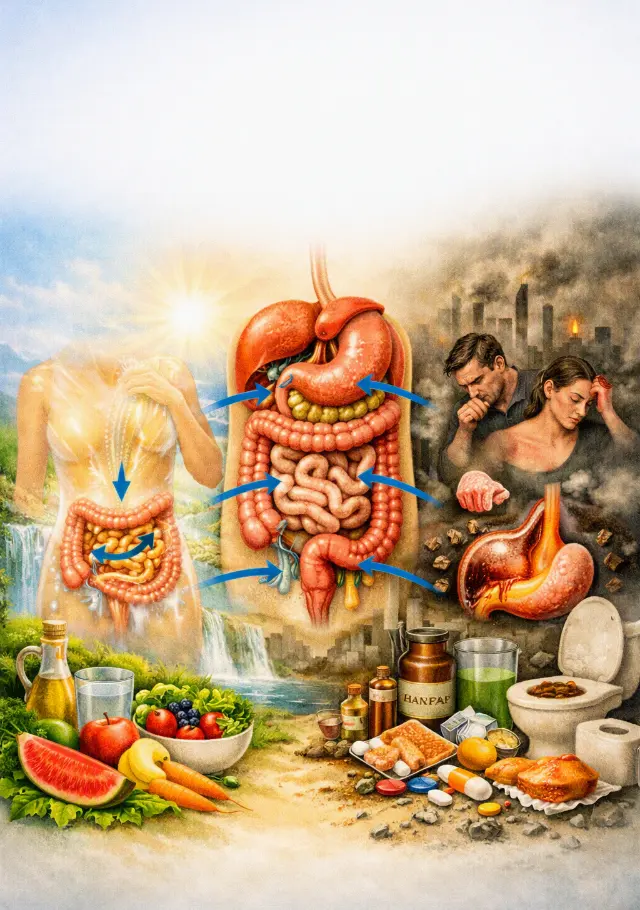
The digestive tract is at the heart of the theory of elimination. Far from being merely an organ of absorption and digestion, it constitutes a major excretory organ through which the body ejects some accumulated waste. Chronic digestive diseases — colitis, microscopic colitis, ulcerative colitis, Crohn's disease — should be understood not as isolated abnormalities, but as manifestations of a cleansing process.
Conventional medicine considers them incurable or difficult to treat. Usual therapies (antispasmodics, corticosteroids, immunosuppressants, surgery) merely alleviate symptoms or slow progression. Yet careful patient observation and study of biological mechanisms reveal a different logic: these conditions reflect the body's effort to expel unwanted molecules, often originating in modern food and intestinal permeability.
Thus functional colitis, so common and distressing, appears as chronic inflammation of the colonic wall caused by dietary and bacterial macromolecules passing from the small intestine. Leukocytes infiltrate the mucosa and transport this waste towards the digestive lumen, triggering pain, bloating and altered bowel habits. Less common microscopic colitis follows the same logic: excess peptides or fibroblast stimulation cause collagen deposits or an influx of lymphocytes. Ulcerative colitis, however, appears to involve another mechanism, linked to direct mucosal injury by bacteria or digestive residues, explaining the relative failure of the hypotoxic diet. Crohn's disease represents a giant colitis, where the intensity of leukocyte infiltration and the complexity of waste to eliminate cause ulcerations, granulomas, fistulas and extraintestinal involvement.
The guiding thread is clear: modern food is the primary cause. By favouring small-intestinal permeability and introducing indigestible molecules, it overloads the elimination system. By eliminating domesticated cereals and dairy products and favouring raw and organic foods, the hypotoxic diet reduces harmful intake and restores cleansing capacities. Clinical results are remarkable in colitis and Crohn's disease, more modest in ulcerative colitis, but always bring hope.
In this document, Family Clinic sets out, chapter by chapter, the logic of these chronic digestive diseases in light of the theory of elimination. It shows that understanding cleansing mechanisms, far from being a theoretical curiosity, opens a practical therapeutic path: clear accumulated waste from the digestive tract to relieve and sometimes cure conditions considered incurable.
Colitis (functional bowel disorder)
Functional colitis, also called spastic colon or irritable bowel syndrome, is one of the most common digestive conditions. It affects around one quarter of the French population and accounts for nearly half of gastroenterology consultations. Although considered benign, it causes chronic suffering and despair for patients and physicians alike, because conventional treatments offer only partial relief and never a definitive cure.
Symptoms
Colitis manifests through three major signs:
- Recurring abdominal pain.
- Bloating linked to excessive fermentation.
- Altered bowel habits: constipation, diarrhoea or alternating between the two.
Additional, inconsistent symptoms include urgent stools, a feeling of incomplete evacuation, chronic fatigue, anxiety, palpitations, sweating, nausea, urinary or genital problems, and joint pain. Clinical examination reveals tenderness along the colon, particularly at the caecum and sigmoid, but no organic lesion.
Limitations of conventional treatments
Intestinal protective agents, antispasmodics, analgesics, mucilages, agents slowing bowel transit, spa treatments or acupuncture provide only temporary relief. Psychotherapy and tranquillisers are ineffective. Colitis is therefore considered incurable by conventional medicine.
Explanatory hypotheses
Several mechanisms have been proposed:
- Immune response against bacterial flora: unconfirmed, because the colonic infiltrate is primarily inflammatory.
- Food hypersensitivity: foods trigger attacks, but are not the primary cause.
- Altered digestive motility: a consequence of inflammation, not the initial cause.
- Psychopathology: an abandoned hypothesis, psychological disturbances being secondary to pain and ionic losses.
- Chronic inflammation of the colonic wall: the only coherent hypothesis, confirmed by excessive leukocytes (mast cells, macrophages, T lymphocytes).
The proposed mechanism
Functional colitis is explained by an elimination process:
- Modern food and certain bacteria attack the small-intestinal mucosa.
- Intestinal hyperpermeability: passage of dietary and bacterial macromolecules into the blood.
- Transport of this waste by leukocytes towards the colonic wall.
- Permanent immune-cell infiltrate, causing chronic inflammation and characteristic symptoms.
The primary damage is therefore in the small intestine, with the colon affected secondarily. The danger comes from the blood rather than the colonic lumen.
Results of the hypotoxic diet
A study of 237 patients with primary colitis shows spectacular results:
- 233 complete remissions in approximately one month.
- Progressive disappearance of pain, bloating, altered bowel habits, fatigue and episodes of discomfort.
- Restored tolerance of raw vegetables and fruit after a few days.
- Possible persistence of intermittent diarrhoea, a sign of a painless cleansing process that should be respected.
Only a few cases resist (dolichocolon or anatomical abnormalities). But for most, the hypotoxic diet provides lasting remission, provided it is maintained throughout life. Resuming wheat or milk causes immediate relapse.
In summary: Functional colitis is an elimination disorder: the colon becomes the site for ejecting dietary and bacterial waste transported from the small intestine. Chronic inflammation is the consequence of this process. By eliminating incompatible modern foods and favouring raw products, the hypotoxic diet reduces harmful intake and restores elimination. Unlike conventional treatments, it provides lasting remission and restores normal quality of life to patients.
Microscopic colitis
Microscopic colitis constitutes a particular, less common form of colonic disease. It mainly affects adult women and is distinguished by subtle but disabling symptoms and lesions invisible on conventional endoscopy. Diagnosis relies exclusively on histological examination of colonic biopsies.
Symptoms
The major sign is fluctuating chronic watery diarrhoea, sometimes accompanied by:
- Moderate abdominal pain.
- Alternating diarrhoea/constipation.
- Nausea and vomiting.
General health remains preserved, without notable weight loss. Radiological and endoscopic examinations are normal, making diagnosis difficult.
Histological types
Two main forms are distinguished:
- Collagenous colitis: a band of collagen deposited beneath the colonic epithelium's basement membrane.
- Lymphocytic colitis: an inflammatory infiltrate rich in lymphocytes, with at least 20 lymphocytes per 100 epithelial cells.
These forms of colitis are often associated with autoimmune diseases or inflammatory rheumatic conditions, as well as small-intestinal villous atrophy.
The proposed mechanism
Their origin remains mysterious, but they can be interpreted as elimination disorders:
- In collagenous colitis, certain waste stimulates fibroblasts to produce collagen.
- In lymphocytic colitis, peptides crossing the small-intestinal mucosa are presented to T lymphocytes, triggering their massive influx.
The differences between conventional and microscopic colitis would thus arise from the nature of the waste to be cleared.
Clinical observation (reported case)
A 32-year-old woman suffered from an inflammatory rheumatic condition resembling ankylosing spondylitis, associated with collagenous colitis. She observed a seesaw phenomenon:
- The more diarrhoea increased, the more joint pain decreased.
- The more diarrhoea decreased, the more the rheumatic condition worsened.
The hypotoxic diet led to complete disappearance of digestive and joint symptoms. Relapses occurred when the diet was abandoned, remissions when it was resumed.
In summary: Microscopic colitis perfectly illustrates the logic of the theory of elimination:
- Waste crosses the small-intestinal mucosa.
- It is transported by leukocytes towards the colonic mucosa.
- Its expulsion causes chronic inflammation, reflected in collagen deposits or lymphocyte influx.
By reducing harmful intake and favouring elimination, the hypotoxic diet may bring significant improvement or even remission.
Ulcerative colitis (UC)
Ulcerative colitis (UC) is a chronic inflammatory condition of the colon and rectum. It differs from functional colitis and Crohn's disease in its particular mechanism and the nature of its lesions. Although less severe than Crohn's disease, it remains disabling and difficult to treat.
Symptoms
The major signs are:
- Frequent diarrhoea, with liquid stools containing blood and/or mucus.
- Tenesmus: anal burning and a painful urge to pass stool.
Other manifestations may occur: abdominal pain, fever, moderate anaemia. General health is rarely impaired and weight loss is limited.
Observed lesions
- Endoscopy: red, friable rectal and colonic mucosa, bleeding on contact, with continuous distribution of lesions.
- Histology: superficial damage limited to the mucosa, reduction or disappearance of mucus cells, absence of inflammatory granulomas.
UC progresses through flare-ups separated by spontaneous remissions. Some forms are serious because of flare-up duration or symptom intensity, but overall the disease is less severe than Crohn's disease.
Differences between UC and Crohn's disease
Although clinically similar, the two diseases are distinct:
- UC: superficial, continuous lesions limited to the rectum and colon.
- Crohn's disease: transmural, discontinuous lesions that can affect the entire digestive tract, with granulomas and complications (fistulas, abscesses, strictures).
- Tobacco: protective in UC, aggravating in Crohn's disease.
- Artificial nutrition and the hypotoxic diet: of limited effectiveness in UC, often beneficial in Crohn's disease.
Results of the hypotoxic diet
Unlike functional colitis and Crohn's disease, the hypotoxic diet has shown no significant benefit in UC. Patients experience remissions, but these are comparable to the usual spontaneous remissions. All relapse after a variable period.
Reflections on the mechanism
UC does not appear to be an elimination disorder.
- Superficial lesions suggest injury coming from the colonic and rectal lumen (bacteria, digestive residues), rather than the blood.
- Reduction or disappearance of mucus cells deprives the mucosa of its natural protection, making it vulnerable.
- Unlike Crohn's disease, where mucus cells are hyperactive, UC is characterised by failure of the mucosal barrier.
Genetic factors or a particular accumulation may explain this fragility. In that case, although not curative, the hypotoxic diet could have preventive value.
Ulcerative colitis therefore illustrates a limitation of the theory of elimination: not all chronic digestive diseases involve the same mechanism. Unlike functional colitis and Crohn's disease, UC appears linked to direct mucosal injury by local agents, aggravated by the absence of protective mucus. The hypotoxic diet does not provide a cure, but may help reduce risks or prevent worsening in predisposed people.
Crohn's disease
Crohn's disease is a chronic inflammatory condition of the digestive tract whose frequency has increased considerably over the last century. Once rare, it now affects around 4 people in 1,000, with a predilection for Anglo-Saxon, Scandinavian and Jewish populations. It generally begins between ages 20 and 30, sometimes between 50 and 60, and affects both sexes.
Symptoms
Clinical signs vary:
- Persistent abdominal pain.
- Prolonged diarrhoea, sometimes bloody and containing mucus.
- A palpable mass in the right iliac fossa.
- Moderate fever, fatigue, weight loss.
- Laboratory abnormalities: raised erythrocyte sedimentation rate, elevated CRP, mild anaemia, leukocytosis, hypoalbuminaemia.
Characteristic lesions
Histological damage involves the full thickness of the intestinal wall:
- Submucosa: infiltrate of granulocytes, macrophages, T and B lymphocytes, plasma cells and mast cells. Granulomas with multinucleated giant cells and microabscesses are present.
- Mucosa: ulcerations, shortened villi, deformed crypts.
- Complications: fistulas, fissures, large abscesses, scar-related strictures.
Inflammation may extend to the mesentery and lymph nodes.
Extraintestinal manifestations
Crohn's disease is not confined to the digestive tract. It may affect:
- Joints: peripheral arthritis, ankylosing spondylitis, sacroiliitis.
- Skin: erythema nodosum, pyoderma gangrenosum.
- Mouth: ulcers, lip oedema, gingivitis.
- Eyes: uveitis, episcleritis.
- Liver and biliary tract: chronic hepatitis, steatosis, gallstones, sclerosing cholangitis.
The proposed mechanism
Crohn's disease is an elimination disorder:
- Modern food and putrefactive flora weaken the small-intestinal mucosa.
- Intestinal hyperpermeability: massive passage of dietary and bacterial macromolecules.
- Leukocytes (macrophages, granulocytes) capture this waste and transport it through the intestinal wall.
- The leukocyte infiltrate causes chronic inflammation, releasing cytokines and free radicals.
- Granulomas and microabscesses reflect exhaustion of leukocytes saturated with toxins.
- Ulcerations result from epithelial shedding, opening of microabscesses and oxidative injury.
Crohn's disease thus appears as a giant colitis, where the intensity of the elimination process causes transmural lesions and severe complications.
Genetic factors and multifactorial causation
Crohn's disease is multifactorial. Susceptibility genes play an important role:
- The frequency in identical twins reaches 44%.
- The NOD2 gene (chromosome 16) is mutated in around 20% of patients. It encodes a receptor expressed on monocytes/macrophages, involved in recognising bacterial structures.
These genetic abnormalities explain some people's particular vulnerability.
Course and treatments
The disease progresses through flare-ups and often incomplete remissions. Conventional treatments (salicylates, corticosteroids, immunosuppressants, TNFα inhibitors, surgery) offer only partial control. After 15 years, 90% of patients have undergone mutilating surgery, but recurrence is almost constant.
The hypotoxic diet, by contrast, produces remarkable results: reduced harmful intake, progressive waste clearance, lasting improvement, sometimes complete remission. Unlike UC, Crohn's disease responds favourably to nutritional reform.
In summary: Crohn's disease perfectly illustrates the logic of the theory of elimination: an overload of dietary and bacterial waste causes massive leukocyte infiltration and chronic transmural inflammation. Granulomas, ulcerations and complications are simply consequences of an intensive cleansing process. By reducing intake and favouring elimination, the hypotoxic diet constitutes a major therapeutic path capable of bringing lasting improvement in a disease considered incurable.
General conclusion
Chronic digestive diseases — functional colitis, microscopic colitis, ulcerative colitis and Crohn's disease — become coherent when analysed in light of the theory of elimination. The digestive tract is not only a site of absorption: it is also a major excretory organ responsible for ejecting unwanted waste from the body.
Functional colitis perfectly illustrates this mechanism: leukocytes transport dietary and bacterial macromolecules from the small intestine towards the colonic wall, causing chronic inflammation. By eliminating incompatible modern foods, the hypotoxic diet allows remission in almost every case.
Less common microscopic colitis follows the same logic, but the nature of waste to be cleared (peptides, collagen) determines the histological form. Here too, nutritional reform brings notable improvements.
Ulcerative colitis, however, appears to involve another mechanism: direct mucosal injury by local agents, aggravated by disappearance of mucus cells. The hypotoxic diet has little effectiveness here, highlighting that not all digestive diseases strictly involve elimination.
Finally, Crohn's disease appears as a giant colitis, where the intensity of the elimination process causes transmural lesions, granulomas, fistulas and extraintestinal involvement. The hypotoxic diet shows remarkable results here, confirming that modern dietary overload is the primary cause.
In sum, elimination disorders of the digestive tract reveal a fundamental truth: health depends as much on our ability to eliminate as on our ability to absorb. Chronic digestive diseases are not inevitable: they reflect the body's effort to rid itself of unwanted waste. By respecting this process and reducing harmful intake through nutritional reform, it is possible to prevent, alleviate or even cure conditions considered incurable.