
Foreword
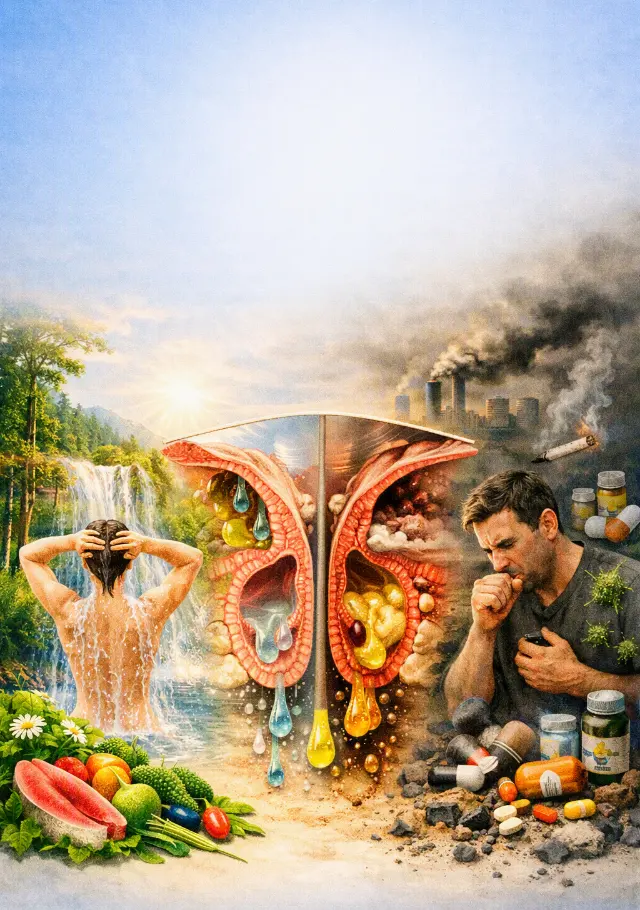
The bronchi are not merely air passages: under certain conditions, they can become a major excretory organ, responsible for expelling unwanted waste outside the body. Chronic respiratory diseases — chronic bronchitis and asthma — should be understood not as simple local abnormalities, but as manifestations of an elimination process.
Chronic bronchitis illustrates this mechanism: the bronchial wall, infiltrated by leukocytes, becomes inflamed and secretes excess mucus to eject dietary and bacterial macromolecules. Conventional treatments (antibiotics, corticosteroids, bronchodilators) merely alleviate symptoms without addressing the cause. By reducing harmful intake, the hypotoxic diet often allows lasting remission, provided it is introduced early, before irreversible complications (emphysema, bronchiectasis).
Asthma, whether extrinsic or intrinsic, also appears as an elimination disorder: leukocytes transport waste towards the bronchial wall, causing chronic inflammation and mucus hypersecretion. Attacks of breathlessness reflect the effort to expel waste, aggravated by allergens, pollutants, stress or cold. Here too, the hypotoxic diet proves capable of reducing attacks, or even eliminating them, by drying up the flow of harmful macromolecules.
These respiratory diseases, often considered incurable or only controllable through symptomatic treatment, find a new logic in the theory of elimination. They express the body's vital effort to rid itself of unwanted waste. By respecting this process and supporting elimination through nutritional reform, it is possible to prevent, alleviate or even cure respiratory conditions considered incurable.
Chronic bronchitis
Chronic bronchitis is a common and serious condition: it affects around 1 in 20 French people and causes twice as many deaths as lung cancer. It is defined by a persistent cough, often accompanied by mucopurulent sputum, lasting at least three months a year for two consecutive years, without a specific ear, nose, throat or pulmonary cause.
Contributing factors
- Smoking: one third of smokers develop chronic bronchitis.
- Atmospheric pollution: particularly in large cities.
- Occupational exposures: dust, inhaled pollutants.
- Severe respiratory infections in childhood.
- Low socioeconomic status.
- α1-antitrypsin deficiency (rare), causing vulnerability to elastases.
Lesions
Chronic bronchitis affects the entire bronchial tree:
- Thickening and shedding of the mucosa.
- Hypersecretion by mucus glands.
- Oedema of the submucosa.
- Leukocyte infiltrate (neutrophils, macrophages, CD8 T lymphocytes).
Complications
- Bronchial obstruction: due to oedema, secretions and sometimes muscle spasm (asthmatic bronchitis).
- Bronchial emphysema: irreversible alveolar distension through destruction of elastin.
- Fibrosis and bronchiectasis: consequences of enzymatic injury from leukocytes.
- Respiratory failure: breathlessness, hypoxaemia, hypercapnia, potentially progressing to heart failure.
Conventional treatments
Smoking cessation, mucolytics, bronchodilators, antibiotics, NSAIDs, corticosteroids, physiotherapy, oxygen therapy. These measures limit exacerbations but do not prevent disease progression.
Interpretation through the theory of elimination
Chronic bronchitis is an elimination disorder:
- The bronchial wall becomes an excretory organ for dietary and bacterial waste from an excessively permeable small intestine.
- Leukocytes transport these molecules towards the bronchi, causing chronic inflammation.
- By aggravating intestinal permeability, antibiotics and corticosteroids sustain the vicious circle.
Results of the hypotoxic diet
In almost all patients, remissions are complete, with disappearance of recurring bronchial infections and discontinuation of medication. Failure is observed in patients with irreversible complications (emphysema, bronchiectasis). The diet must therefore be introduced early, before permanent destruction of elastic tissues.
In summary: Chronic bronchitis illustrates the logic of the theory of elimination: the bronchi become a site for ejecting dietary and bacterial waste, at the cost of chronic inflammation. Conventional treatments fail to cure because they do not address the cause. By reducing harmful intake and limiting intestinal permeability, the hypotoxic diet allows lasting, sometimes spectacular remission, provided it is introduced early.
Asthma
Asthma is a chronic respiratory condition increasing sharply in industrialised countries: its frequency continues to rise in children and adults alike. It manifests as sudden attacks of breathlessness, with bronchial obstruction, wheezing and expectoration of thick mucus.
Types of asthma
- Extrinsic asthma (60%): often begins in childhood, triggered by allergens (dust mites, animal hair, insects, moulds, pollen, certain foods). Skin tests and the presence of specific IgE confirm its allergic origin.
- Intrinsic asthma (40%): occurs in adults, without any identified allergy.
Course and severity
- Some childhood forms disappear at puberty, but most persist throughout life.
- Severe forms can cause airway remodelling: muscle hypertrophy, mucus-gland hyperplasia, subepithelial fibrosis, destruction of bronchial elasticity.
- Asthma can be fatal, either through a severe acute attack or chronic respiratory failure.
Conventional treatments
Bronchodilators, anti-inflammatory drugs, antileukotrienes, corticosteroids, desensitisation courses. These measures reduce attacks but do not cure the disease.
Interpretation through the theory of elimination
Asthma is a bronchial elimination disorder:
- Dietary and bacterial macromolecules from an excessively permeable small intestine are transported by leukocytes towards the bronchial wall.
- The inflammatory infiltrate (neutrophils, macrophages, lymphocytes, mast cells, eosinophils) sustains chronic inflammation.
- Waste is expelled in bronchial secretions and shed cells.
- Inflammation increases bronchial muscle excitability, making attacks triggerable by allergens, pollutants, cold, exercise or stress.
- The danger therefore comes from the blood and intestine, not only from inhaled air.
Results of the hypotoxic diet
In the great majority of patients with asthma, remission is complete or almost complete within a few weeks to a few months. The diet is effective in both extrinsic and intrinsic asthma, especially when introduced early, before irreversible damage.
Clinical observations
- Observation ALL 1: an 18-year-old young man with extrinsic asthma and weekly attacks. Desensitisation failed. The hypotoxic diet eliminated attacks in 7 months, with no relapse for 18 years.
- Observation ALL 64: a 56-year-old female physician with extremely severe asthma, repeated status asthmaticus, respiratory failure and coma. After adopting the original diet, spectacular improvement: disappearance of bronchial oedema, removal of the tracheostomy, return to normal life.
In summary: Asthma illustrates the logic of the theory of elimination. The bronchi become a site for ejecting dietary and bacterial waste, at the cost of chronic inflammation and muscle hyperreactivity. Conventional treatments fail to cure because they do not address the cause. By reducing harmful intake and limiting intestinal permeability, the hypotoxic diet allows lasting, sometimes spectacular remission, even in forms considered incurable.
General conclusion
Chronic respiratory diseases (chronic bronchitis and asthma) become coherent when analysed in light of the theory of elimination. Far from being simple air passages, the bronchi become a major excretory organ, responsible for expelling dietary and bacterial waste outside the body.
- In chronic bronchitis, the bronchial wall is infiltrated by leukocytes, inflamed and hypersecretory. Mucopurulent sputum reflects the effort to expel waste. Conventional treatments (antibiotics, corticosteroids, bronchodilators) merely alleviate symptoms without addressing the cause. By reducing harmful intake, the hypotoxic diet often allows lasting remission, provided it is introduced early, before irreversible complications (emphysema, bronchiectasis).
- In asthma, leukocytes transport macromolecules towards the bronchial wall, causing chronic inflammation and mucus hypersecretion. Attacks of breathlessness reflect the effort to expel waste, aggravated by allergens, pollutants, cold or stress. The hypotoxic diet proves capable of reducing attacks, or even eliminating them, by drying up the flow of harmful molecules.
These respiratory diseases, often considered incurable or only controllable through symptomatic treatment, find a new logic in the theory of elimination. They express the body's vital effort to rid itself of unwanted waste. By respecting this process and supporting elimination through nutritional reform, it is possible to prevent, alleviate or even cure respiratory conditions considered incurable.