
Foreword
Enzymes are the invisible keys of life. They speed up reactions, open the doors of health and silently watch over our cells' balance. Without them, life would be frozen, motionless and unable to unfold.
This booklet continues the book Cuisiner pour guérir (Cooking to Heal, 2026). It unites biochemical rigor with the wisdom of hypotoxic nutrition. It tells how these fragile yet powerful catalysts can be protected, nourished and honored through respectful nutrition close to that of our ancestors.
It invites understanding, but also feeling: seeing in every enzyme a spark of life, and in every meal an offering that supports their invisible dance.
Medicine that takes enzymes into account respects life at its foundations. It does more than treat symptoms; it seeks to preserve the intimate balance of reactions that animate us. It recognizes that modern food, too rich in foreign molecules and too poor in essential nutrients, puts this enzyme capacity at risk.
This booklet is therefore a guide, but also a companion. It invites you to rediscover the simplicity of foods, recover the strength of natural nutrients and restore enzymes to the center of your health.
Definition and main characteristics
Enzymes are indispensable biological catalysts. They accelerate the body's chemical reactions, sometimes several millionfold, allowing life to proceed within timescales compatible with human existence. They remain intact after their work, like discreet artisans.
They are specific, each connected to a substrate and faithful to a single action. They are not master keys, but precise keys adapted to a unique lock. Produced by our cells, they are mostly proteins, but some RNAs, called ribozymes, also have catalytic activity.
Their number is immense. More than 2,500 have been identified, but humans may possess nearly 16,000. Each is a key in life's keyring, opening a door to a vital reaction.
Application to hypotoxic nutrition
Hypotoxic nutrition takes care not to break these fragile keys. The recipes in Cuisiner pour guérir (Cooking to Heal, 2026) favor simple foods, raw or lukewarm, that respect enzymatic delicacy and allow these catalysts to play their role unhindered. A quinoa and beetroot salad or a light lentil soup becomes a silent ally that allows enzymes to play their role unhindered.
How enzymes work
At the heart of every enzyme lies an active site, an intimate pocket where the substrate settles. The encounter is precise, almost loving: key and lock, glove and hand. For a moment, enzyme and substrate become one, and the reaction can take place.
This harmony is fragile. An enzyme recognizes only one isomer, just as a right hand cannot fit into a left glove. Temperature and pH are its allies or enemies: pepsin acts in the acidity of the stomach, trypsin in the alkalinity of the intestine.
Some enzymes exist in several forms, called isoenzymes, capable of catalyzing the same reaction. They sometimes compensate for a deficiency. Others are unique and irreplaceable.
Application to hypotoxic nutrition
Hypotoxic recipes respect this fragile harmony. They offer gentle fruit compotes and lukewarm root vegetable salads that match the optimal conditions for our digestive enzymes. Every meal becomes a harmonious encounter between substrate and catalyst.
Inhibitors and activators
Enzymes, so precise and powerful, can be slowed or awakened by molecules that disrupt or support their action. Inhibitors are silent adversaries: some take the substrate's place, like impostors settling in the lock without ever opening the door. These are competitive inhibitors. Others, the noncompetitive inhibitors, bind elsewhere at an allosteric site and distort the lock itself, making the key useless. Finally, irreversible inhibitors seal their hold through a covalent bond, condemning the enzyme to inactivity.
But there are also allies. Activators are companions that restore breath and vigor. Cations (magnesium, manganese, calcium, iron, copper, zinc and selenium) are precious stones that stabilize the enzyme's shape, facilitate its encounter with the substrate or participate directly in the reaction. Some enzymes can act only with a single cation, such as glutathione peroxidase, which depends on selenium. Others accept substitutions, such as magnesium and manganese.
Activators can also be other enzymes that turn a proenzyme into an active enzyme, or covalent modifications such as phosphorylation, which acts like a molecular switch.
Application to hypotoxic nutrition
Hypotoxic nutrition is a way of supporting these natural activators. Green vegetables provide magnesium, legumes manganese, dried fruit and nuts zinc, and nuts selenium. Every meal becomes an offering that awakens life's catalysts. In Cuisiner pour guérir (Cooking to Heal, 2026), recipes are designed to enrich the body with these essential elements so enzymes can accomplish their mission unhindered.
Enzyme regulation
Enzyme activity is not a continuous flow, but a regulated dance. It must accelerate when the cell needs to produce a metabolite, slow or stop when the amount is sufficient. Three levels of control orchestrate this symphony.
Allosteric control is immediate: substrate binding increases the enzyme's affinity, or an inhibitor settles on an allosteric site to reduce activity. This is rapid regulation, like a breath changing the wind's direction.
Control through covalent modification is slower. Hormones trigger intracellular signaling that changes the enzyme from an inactive to an active form, or vice versa. This regulation lasts longer, like a season settling in.
Finally, transcriptional control is the deepest. It acts at the DNA level, regulating transcription of the gene encoding the enzyme. This is lasting regulation, written into genetic memory, like a tradition passed from generation to generation.
Enzymes often operate in cascades, each stage depending on the previous one. Regulation generally acts at the first enzyme in the cascade, like a key opening or closing the flow.
Application to hypotoxic nutrition
Hypotoxic nutrition protects this cascade by avoiding modern disruptors. Whole, organic, simple foods allow enzymes to flow freely, like a pure river. In Cuisiner pour guérir (Cooking to Heal, 2026), each recipe is designed to respect this fluidity, supporting rather than blocking enzyme cascades.
Classification of enzymes
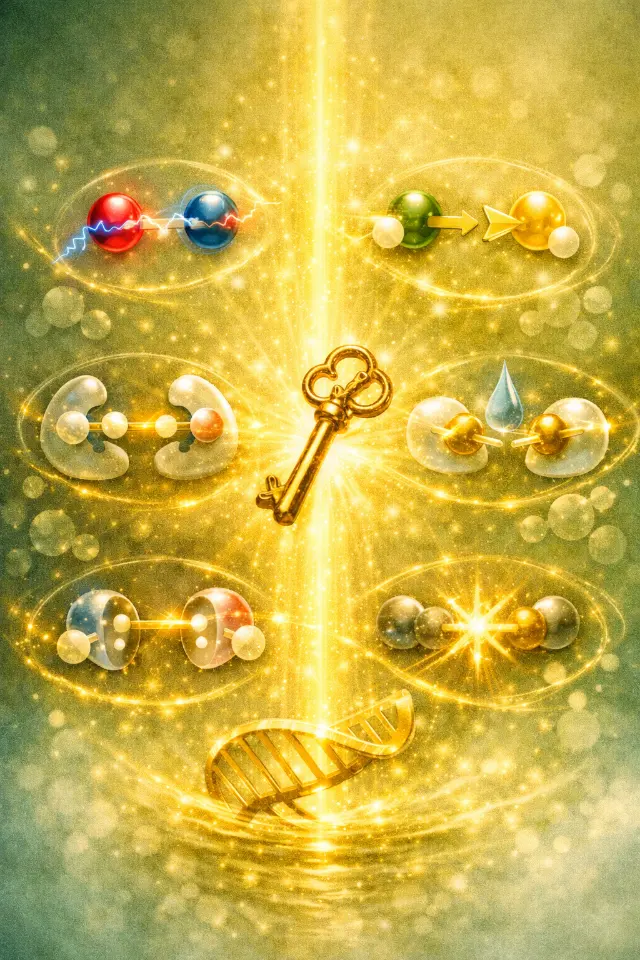
Enzymes are numerous, but can be grouped into six major families, each carrying out a particular mission.
Oxidoreductases move electrons, orchestrating oxidation and reduction reactions. Transferases move atoms or groups of atoms, like messengers carrying precious cargo. Hydrolases break bonds using water, like sculptors using fluidity to separate forms. Lyases break bonds in other ways, through subtle mechanisms. Isomerases transform shapes, changing a molecule into its isomer, like a mirror reflecting a reversed image. Finally, ligases create new bonds, consuming energy as ATP and building bridges between molecules.
Each is a different key, each opens a unique door in life's great palace.
Application to hypotoxic nutrition
Hypotoxic recipes provide the cofactors these families need through fruit, vegetables, seeds and legumes. Every dish becomes an offering to an enzyme family. In Cuisiner pour guérir (Cooking to Heal, 2026), the 200 hypotoxic recipes are designed to nourish these families so every enzyme finds its partner and accomplishes its mission.
Coenzymes
Coenzymes are enzymes' indispensable companions. They are not catalysts by themselves, but complete the action and make catalysis possible. They often arise from vitamins, sometimes from other sources. They are varied, each adapted to a particular enzyme.
Most coenzymes are built from precursors the body cannot make: vitamins. These must be supplied through food. But the correspondence is not always perfect: the lipoic coenzyme does not come from a vitamin, and vitamins A and D are not sources of coenzymes.
Application to hypotoxic nutrition
The recipes in Cuisiner pour guérir (Cooking to Heal, 2026) incorporate foods rich in B vitamins, whole grains and legumes that nourish these silent companions. Every dish becomes a way to support coenzymes, and therefore enzymes themselves.
Enzyme capacity
Every human being possesses a unique enzyme capacity, a true biological signature of inner balance. This invisible inheritance consists of a set of enzymes ensuring the construction, breakdown, transformation and regeneration of vital molecules. Some enzymes are vigorous and fast, others subtle and fragile, but all participate in the metabolic symphony sustaining life.
Genetic mutations shape this capacity: they create enzyme variants, sometimes more efficient, sometimes deficient. Glucose-6-phosphate dehydrogenase, a key enzyme in energy metabolism, thus exists in dozens of forms: some ensure normal activity; others cause increased sensitivity to oxidative stress.
Enzyme deficiencies are rarely quantitative: the enzyme is present but structurally altered, losing some effectiveness. Every individual therefore has a personal enzyme arsenal whose value depends on these enzymes' quality and ability to cooperate.
This capacity determines resistance to assaults, the speed of metabolic reactions and the ability to eliminate waste. When an essential enzyme malfunctions, waste builds up in the body: reactions slow, toxins accumulate and tissues become exhausted. This enzymatic vulnerability explains why some people are more exposed to waste-accumulation diseases, digestive disorders or autoimmune conditions.
Application to hypotoxic nutrition
Preserving this capacity means honoring the simplicity of life. Hypotoxic nutrition acts as biological armor: it protects enzymes from chemical assaults and metabolic overload. It bans refining, excessive cooking, additives and saturated fats, favoring intact, fresh, natural foods. In Cuisiner pour guérir (Cooking to Heal, 2026), every recipe is designed to support enzyme capacity, nourish essential cofactors and maintain the fluidity of vital reactions. Every meal thus becomes an act of preservation, a way of strengthening this invisible treasure connecting genetics to everyday health.
The enemies of enzymes
Enzymes, so precious, are also vulnerable. They can be attacked, inhibited and destroyed by invisible enemies. Free radicals, born of oxidation, eat away at their structures as rust attacks metal. Pesticides, additives, medicines, tobacco, pollutants and radiation are all silent aggressors that damage their delicacy.
But the most insidious enemy is sometimes on our plate. Modern dietary molecules, refined, processed and saturated with sugars and fats, disrupt enzyme balance. A permeable intestine lets through fragments that should not cross the barrier, and these intruders block or divert enzymes. The consequences are serious: autoimmune conditions, waste-accumulation diseases and elimination disorders.
Application to hypotoxic nutrition
Hypotoxic nutrition is armor against these enemies. It bans excessive cooking, refining and additives. It favors simple, natural, respectful foods. In Cuisiner pour guérir (Cooking to Heal, 2026), every recipe is protection, a way of preserving enzymes against daily assault.
Medicine adapted to enzymes
Caring for enzymes means caring for life itself. They are the silent artisans of every biological reaction: they transform, regulate, repair and orchestrate the body's balance.
Modern medicine, aware of their central role, must learn to respect, nourish and protect them.
Micronutrition provides vitamins, minerals and essential fatty acids serving as cofactors for these enzymes. Without them, catalysis falters, reactions slow and vitality fades.
Hypotoxic macronutrition, meanwhile, chooses foods our enzymes recognize: simple, living products close to those of our ancestors, far from excessive refining and chemical overload. It is an approach of biological coherence, in which science meets the wisdom of life.
Medicine adapted to enzymes is a medicine of respect. It does not force: it supports. It does not destroy: it protects. It recognizes that every enzyme is a unique key and that health depends on the fluidity of their actions.
It is medicine that listens to the body, understanding that healing comes not from constraint, but from restoring enzymatic movement.
Application to hypotoxic nutrition
The recipes in Cuisiner pour guérir (Cooking to Heal, 2026) embody this philosophy. They are therapeutic tools, allies of prevention and care. Every dish is designed to support enzymes, offering the nutrients and conditions they need to act freely. Cooking thus becomes gentle medicine, an act of daily care: every meal becomes a prescription for health, a way of nourishing life at its source.
Conclusion
Enzymes are the invisible pillars of health, the subtle keys opening the doors of life.
They express the perfection of life: every movement, breath and thought depends on their silent action. They transform raw matter into energy, a molecule into a message and disorder into balance.
But these artisans of life are fragile. Their effectiveness depends on our environment, food and respect for biological rhythms. Protecting them means preserving life's intimate machinery, connecting the cell to awareness and nutrition to health.
Hypotoxic nutrition is the natural path to supporting this enzyme capacity. It respects balances, avoids excess and restores clarity to the body's reactions. It is not a constraint but a reconciliation: between science and nature, physiology and wisdom.
This booklet, continuing Cuisiner pour guérir (Cooking to Heal, 2026), offers an integrated vision: medicine uniting biochemistry and nutrition, prevention and healing, knowledge and the pleasure of living.
Preserving enzymes means preserving life. Nourishing them means nourishing the future. Respecting them means honoring the fragile balance keeping us healthy. And in every mindful meal, every act of care, lies a promise: a body regaining its fluidity, light and freedom.