
Foreword
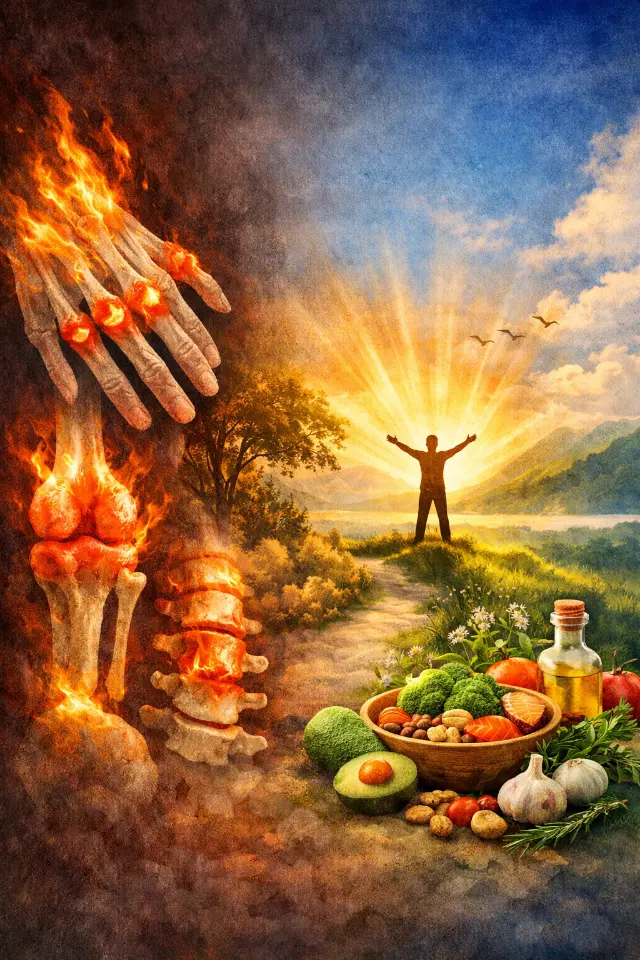
Joint pain is an ancient language that our bodies sometimes speak without our knowing how to translate it. It arises in the hands, knees, and shoulders and transforms everyday movements into silent ordeals. Inflammatory rheumatic conditions, whether known or still unclassifiable, remind us that our body's balance is fragile and that modern diets, too rich in excess, can become an invisible enemy.
But these diseases are more than medical definitions: they are life stories. They strike the child who can no longer run, the woman who can no longer raise her arms, the man whose nights are consumed by pain. They impose limits, but they also reveal a strength: that of searching, hoping, and rising again.
In this booklet, every chapter tells a story: that of a patient, a joint, a healing that is sometimes partial, sometimes complete. Every page is a bridge between science and life, between the rigor of diagnosis and the poetry of new beginnings.
We believe that returning to a simpler diet, closer to our origins, can ease these pains and give bodies back the freedom to move. This path is not always linear: it requires patience and trust, but it opens a way toward restored health and harmony between people and their environment.
General introduction
Inflammatory rheumatic conditions are both ancient and modern diseases. Ancient, because joint pain has accompanied humanity from its origins; modern, because science discovers new facets of them every day. They are not a single face but a mosaic: psoriatic arthritis, polymyalgia rheumatica, juvenile arthritis, palindromic rheumatism, and unclassifiable forms. Each has its preferred age, its favored joints, and its own course.
These diseases are more than diagnoses: they are human stories. They tell of interrupted lives, broken movements, and difficult mornings. But they also tell of new beginnings: patients who walk again, children who sleep again, adults who regain their breath.
This booklet is a bridge between scientific rigor and human sensitivity. It offers clinical narratives, comparative tables, accounts, and practical advice. It shows that hypotoxic nutrition can become a key: not a miracle solution, but a path toward relief, a way to regain freedom.
We believe that returning to a simpler diet, closer to our origins, can reduce inflammation and restore fluidity of movement to the body. This path requires patience and trust, but opens a prospect of restored health and harmony between people and their environment.
Psoriatic arthritis
Some pains arise in the shadows of the joints, like discreet flames slowly consuming freedom of movement. Psoriatic arthritis, sometimes a silent companion of skin psoriasis, settles in the hands, knees, or spine, with a preference for those small joints that let us grasp the world. Sometimes peripheral, sometimes axial, it slips into life with its own nuances, never quite the same as rheumatoid arthritis but close enough to confuse the doctor's assessment.
This often asymmetric condition attacks the distal interphalangeal joints, leaving fingers marked by stiffness that recalls the fragility of our bodies. Yet it is not always destructive: in most cases, it is less severe and less deforming, as though hesitating to cross the boundary into irreversibility. X-rays reveal different images, distinctive imprints, and rheumatoid factor remains absent, like a signature distinguishing this disease from others.
But beyond numbers and genes lies the human experience: pain on waking, difficulty with everyday movements, and worry about skin already marked by psoriasis. Yet a light breaks through this gray sky: the hypotoxic diet, this return to a more original way of eating, has shown encouraging results. Among dozens of patients, most saw their pain ease, their joints regain flexibility, and sometimes even their skin clear.
Healing of the rheumatic condition and the skin disorder does not always proceed in parallel: often, joints settle before the skin calms. As though the body chose first to free movement, before freeing appearance. Along this path, every improvement, even partial, becomes a victory: a longer walk, a more peaceful night, a recovered smile.
Thus, psoriatic arthritis reminds us that disease is not a fixed, inevitable fate but a dialogue between our cells, diet, and lifestyle. And that sometimes, by returning to simpler food closer to nature, we can give our joints and skin a chance for renewal.
Polymyalgia rheumatica (PMR)
Some pains arise suddenly, like a storm deep in the shoulders and hips. Polymyalgia rheumatica often strikes after fifty, with a suddenness that surprises: the simplest actions become impossible — getting up, dressing, even smiling. The body freezes, mornings stretch out through painful efforts to loosen stiffness, and anxiety settles in the eyes.
Inflamed muscles and synovial tissues seem imprisoned by an inner fire. Fever sometimes accompanies this storm, adding fatigue, weight loss, and sadness. Yet behind this apparent severity, science has discovered leads: lymphocytes, cytokines, and bacterial peptides that could be the invisible architects of this disorder.
In this dark landscape, an unexpected path has opened: diet. Where medications require years to bring relief, an exclusion diet, this return to simpler, purer food, has sometimes transformed life within weeks. Patients confined to a chair have walked again; unbearable pain has dispersed like mist at sunrise.
PMR teaches us that healing is not always a long, monotonous path: it can emerge as a new beginning when the body is no longer attacked by foreign molecules. It also reminds us that vigilance remains necessary: if the shadow of temporal arteritis appears, corticosteroids must protect sight, because blindness can strike without warning.
Thus, polymyalgia rheumatica is a lesson in fragility and hope: the fragility of joints that freeze, the hope of rapid relief through suitable dietary measures. It invites us to listen to our bodies, respect their balance, and believe that even in the sharpest pain, a bright way out can open.
Juvenile chronic arthritis (JCA)
Some children have their childhood stolen by pain. While their footsteps should echo through playgrounds, their knees swell, their wrists become stiff, and their nights fill with fever and tears. Juvenile chronic arthritis, these diseases that strike before sixteen, are early storms in bodies still growing.
The systemic form, called Still's disease, appears with burning fevers, fleeting patches of redness on the skin, and crushing fatigue. It can last for years, sometimes leaving lasting damage, sometimes dying out like an unpredictable flame.
Rheumatoid-factor-negative polyarthritis resembles the adult form but develops in childhood, with swelling, stiffness, and risks of ankylosis. Rheumatoid-factor-positive polyarthritis, rarer, is even more severe: it deforms the hands, slows walking, and imposes painful maturity on the child. Oligoarthritis, more common, affects a few large joints, often the knees. It seems milder but conceals a silent danger: chronic uveitis, which can threaten sight.
Yet amid this suffering, glimmers appear. Some children, through a purer diet closer to our origins, see their pain ease, their nights become peaceful again, and their joints regain some flexibility. Others, sadly, remain trapped in recurrent flare-ups, unresponsive to dietary changes, as though their psychological state or biological constitution resisted every attempt.
JCA reminds us that disease is not solely biological: it is also emotional, linked to stress, anxiety, and intimate vulnerabilities. The psychological state can amplify pain, open gaps in immunity, and allow harmful peptides through. But when it regains balance, it can also offer remission and renewal.
Thus, juvenile chronic arthritis is a lesson in courage. It shows children who, despite pain, continue dreaming, dancing, and chasing life. It invites us to believe that medicine, nutrition, and psychological support together can give these young bodies back the freedom to grow.
Palindromic rheumatism
Some pains appear like lightning, brief but intense, then disappear without leaving a visible trace. Palindromic rheumatism is of this nature: it arises suddenly, strikes a joint violently, then fades within a few days like a passing storm. But it returns, again and again, at regular intervals, reminding us that the body carries a memory of fire within it.
In young adults, these repeated attacks become a mystery: why such sudden pain, why this alternation between calm and lightning? Joints, alternately inflamed and soothed, seem to play an unpredictable score. Anxiety settles in: what will tomorrow bring? A day of freedom or another flare-up?
Yet here too, diet can become a key. Three out of four patients, by adopting an exclusion diet, saw their attacks disappear, as though the body had regained inner peace. The fourth remained unresponsive, proof that every body has its own language and its own resistance.
Palindromic rheumatism teaches us the fragility of time: pain can last three days but leave a far longer imprint on the mind. It also reminds us that healing is not always universal: it can be partial, complete, or elusive. But every attempt contains hope: regaining lightness of gesture, simplicity of movement, and the joy of everyday life without fear.
Thus, this rheumatic condition is a metaphor for life: unpredictable, sometimes cruel, but always open to hope. Along this path, every improvement and every remission becomes an intimate victory, a silent renewal.
Unclassified inflammatory rheumatic conditions
Some pains refuse to be named. They settle in joints, sometimes discreet, sometimes violent, but correspond to no conventional disease. They are not quite rheumatoid arthritis, spondyloarthritis, or psoriatic arthritis. They advance in disguise, like travelers without passports, leaving doctors hesitant before their unclassifiable presentation.
These rheumatic conditions, described as ‘unclassified,’ are mysteries of the body. Over the years, they can transform and reveal their true face: become rheumatoid arthritis, ankylosing spondylitis, or psoriatic arthritis. But sometimes they remain indefinable, as though reminding us that science cannot always confine pain within a precise definition.
Yet even in this uncertainty, a path has opened: nutrition. Fifteen patients tried the path of the hypotoxic diet. Twelve saw marked relief of pain, two experienced partial improvement, and only one remained unresponsive. Behind their apparent coldness, these numbers tell life stories: joints regaining flexibility, less painful mornings, and movements becoming possible again.
Unclassified rheumatic disease teaches patience and humility. It reminds us that not all diseases have found their name, that medicine is an unfinished quest. But it also shows that even without a precise diagnosis, the body can respond to a purer diet more respectful of its balance.
Thus, these anonymous pains become messengers: they invite us to listen to our body, avoid waiting for a label before acting, and believe that healing can emerge even in uncertainty.
Appendix 1 — Comparative tables
Diseases are more than words; they have many faces. To help readers find their bearings, a comparative table brings together the main characteristics of inflammatory rheumatic conditions: age of onset, affected joints, usual course, and results of the hypotoxic diet. At a glance, we can see that psoriatic arthritis favors the small finger joints, polymyalgia affects the proximal parts of the limbs, children are the targets of juvenile arthritis, and some rheumatic conditions remain unnamed. These tables become maps, reference points, and markers for understanding the diversity of pain.
Comparative table of inflammatory rheumatic conditions
| Disease | Typical age of onset | Main joints affected | Usual course | Results of the hypotoxic diet |
|---|---|---|---|---|
| Psoriatic arthritis (PsA) | Young to middle-aged adult | Distal interphalangeal joints, sometimes spine | Often moderate, minimally deforming | 92% benefit (partial or complete) |
| Polymyalgia rheumatica (PMR) | > 50 years, mainly women | Shoulders, hips, proximal muscles | Acute, disabling, but reversible | 94% rapid improvement |
| Juvenile chronic arthritis (JCA) | < 16 years | Knees, wrists, ankles, spine, sometimes eyes | Variable: mild or severe forms | Mixed results, sometimes striking, sometimes failures |
| Palindromic rheumatism | Young adult | Various joints, brief attacks | Repeated, nondestructive flare-ups | 92% disappearance of attacks |
| Unclassified rheumatic conditions | Any age | Various joints, unclassifiable | Uncertain progression, sometimes toward RA or AS | 75% marked improvement |
How to read this table
- Age of onset: each disease has its preferred period, from childhood for JCA to later adulthood for PMR.
- Affected joints: some favor the small finger joints, others the proximal parts of the limbs or large joints.
- Course: some are destructive and chronic, others remain mild or intermittent.
- Results of the hypotoxic diet: nutrition appears as a path of hope, with frequent successes that vary according to the disease.
Appendix 2 — Patient accounts
Science draws nourishment from numbers, but life is told in stories. In this appendix, voices rise, faces appear, and journeys take shape.
The renewal of a woman with PMR
Confined to a chair, unable to stand, she saw her days fade into pain. Her shoulders and hips were imprisoned by an invisible fire. Yet after a few weeks of dietary measures, a miracle began to take shape: pain dispersed, mornings became light again, and walking resumed. Six years later, no relapse. Her account is one of a silent victory achieved through the strength of nutrition and patience.
The child and nighttime fever
A ten-year-old boy, consumed by juvenile arthritis, saw his nights devoured by fever and tears. His swollen joints prevented him from playing; his mornings were battles against stiffness. But a dietary change opened a gap: fevers eased, sleep returned, and with it a smile. This account reminds us that childhood can regain its lightness, even after the storm.
The interrupted dance
A young girl passionate about classical dance, struck by juvenile polyarthritis, saw her dream collapse. Inflamed knees, painful nights, and fatigue kept her away from the stage. The hypotoxic diet offered respite, but it was primarily a change of environment and psychological support that enabled a new beginning. She resumed her studies and regained balance; although dance remains a memory, life opened before her again.
Pains without a name
Some patients suffered from ‘unclassified’ rheumatic conditions, without a precise diagnosis. Fifteen tried the hypotoxic diet: twelve regained mobility, two saw their pain diminish, and only one remained unresponsive. These accounts show that even in uncertainty, hope exists.
Conclusion: These narratives are not statistical proof but human lights. They show that behind every diagnosis is a person, a family, and a hope. They remind us that medicine is a science but also a story of lives, courage, and resilience.
Appendix 3 — Practical advice
Healing is not limited to medications: it is also built through everyday actions, choices at the table, and the way we listen to our body.
Foods to favor
Favor foods that still seem close to the earth and the sun:
- Fresh, colorful vegetables, carrying fiber and light.
- Ripe fruit, rich in vitamins, recalling the sweetness of the seasons.
- Fine plant oils (olive, rapeseed, walnut), which nourish without weighing us down.
- Seeds and legumes, humble but powerful, providing strength and fullness.
These foods are allies: they calm inflammation, strengthen immunity, and restore a flowing energy to the body.
Foods to avoid
Exclude foods that tire the body:
- Dairy products, often poorly tolerated.
- Gluten, which can maintain intestinal permeability.
- Excess meat, heavy and inflammatory.
- Refined sugars, which stimulate without nourishing.
These foods are burdens: they sustain pain, confuse defenses, and steal vitality.
Medical vigilance
The diet is an aid, but it never replaces medical monitoring.
Never stop a treatment without the doctor's advice.
- Watch for complications: uveitis in juvenile arthritis, temporal arteritis in PMR, and skin or kidney involvement in lupus.
- Combine dietary measures with medicine: safety arises from this alliance.
The art of living
Beyond food, there is balance:
- Rest, allowing the body to repair.
- Gentle movement, maintaining flexibility.
- Inner serenity, calming the mind and reducing flare-ups.
Conclusion: This practical advice is not a set of rigid rules but invitations to regain harmony with oneself. It reminds us that health is a journey made of everyday choices, vigilance, and hope. By following these reference points, everyone can play an active role in their healing and transform pain into an opportunity for renewal.
Appendix 4 — Selected bibliography
Knowledge is a tree with deep roots. Every observation, every study, and every account nourishes its branches. This bibliography is not a cold list: it is a living memory, a thread connecting patients' experiences to researchers' work and to reference books from Éditions Family Clinic.
Medical and scientific references
- Kaplan, Youinou, Hariette, Hatron, Fauchais: research on Sjögren's syndrome and its multiple manifestations.
- Laborie, Berthelot, Ziza, Chazerain: investigations of polymyalgia rheumatica and its immune mechanisms.
- Prieur, Vignes, Job-Deslandre, Goumy, Fournie, Grasland, Vinceneux: detailed descriptions of juvenile arthritis and inflammatory rheumatic conditions.
- Sieper, Henderson, Lovell, Picco: leads concerning the role of bacteria, cow's milk, and intestinal permeability in juvenile arthritis.
Reference books — Éditions Family Clinic
- Cuisiner pour guérir (Cooking to Heal; 2026), Dr. SAID ALAOUI Moulay Abdellah — a collection of 200 hypotoxic recipes adapted to Moroccan tastes, a true culinary and therapeutic foundation.
- Family Clinic thematic booklets: practical guides to hypotoxic nutrition, prevention of autoimmune diseases, and health education. Each booklet complements the main book by offering educational syntheses, diagrams, patient accounts, and practical advice.
The meaning of this bibliography
These references are more than evidence: they are companions along the way. They show that medicine is a collective quest in which every researcher contributes a stone, every patient a story, and every practitioner an experience. They remind us that science and life nourish one another. And they emphasize that Family Clinic publications provide a solid, accessible foundation for everyone wishing to incorporate hypotoxic nutrition into everyday life.