
When people talk about the nutrients essential to health, the discussion often focuses on protein, vitamins or omega-3s. Yet one indispensable mineral remains largely unknown to the general public: magnesium.
This low profile is paradoxical, because magnesium takes part in several hundred biological reactions essential to life. Every day, our body uses it to produce energy, make the muscles work, transmit nerve signals, keep the cardiovascular system in balance and support many cellular functions.
You could say that magnesium acts like a silent conductor. When it is present in sufficient quantity, many mechanisms work harmoniously without our being aware of it. On the other hand, when it runs short, various symptoms may gradually appear.
Advancing age makes this question particularly important. Over the years, several factors can contribute to reducing magnesium reserves. Certain modern eating habits encourage insufficient intake. Chronic stress also increases the body’s needs. In addition, certain medications can sometimes influence mineral balance. This combination explains why many older people have intakes below desirable levels.
- One of the first functions affected is energy production. To understand this role, imagine each cell as a small power plant. At every moment, cells produce the energy needed for muscle contraction, brain function, heartbeats and all the activities essential to survival.
Magnesium is involved in a large part of these processes. When it is lacking, some people describe a feeling of persistent fatigue, a lack of drive or greater difficulty recovering after exertion. Of course, fatigue has many possible causes. However, magnesium is one of the elements needed for energy mechanisms to work properly.
- The muscles also depend heavily on this mineral. Every movement of our body results from an extremely precise alternation between muscle contraction and relaxation. Magnesium takes part in this constant regulation.
When reserves become insufficient, certain signs may appear: cramps; involuntary contractions; feelings of muscle tension; more pronounced physical fatigue; slower recovery.
With age, maintaining optimal muscle function becomes essential for preserving mobility and independence. Magnesium thus contributes indirectly to preventing many functional limitations.
- The nervous system is another major user of magnesium. The brain and nerves communicate through extremely complex electrical and chemical signals. Magnesium helps keep these mechanisms stable, in particular by preventing excessive overactivation of certain nerve circuits.
This function explains why this mineral is often associated with emotional balance and resistance to stress. In our modern society, stress has become almost omnipresent. Work pressures, family worries, financial difficulties, information overload and health problems keep the stress mechanisms of many people switched on almost permanently. This situation can create an unfavorable circle.
Stress increases the body’s use of magnesium. Lower reserves can then make some people more sensitive to nervous tension. Sleep sometimes becomes less restorative, fatigue builds up and a feeling of exhaustion can gradually set in. This is why adequate magnesium intake is part of an overall strategy for preserving physical and mental balance.
- Sleep itself seems closely linked to this mineral. Many people notice that periods of nervous tension or intense fatigue are accompanied by lighter or more fragmented sleep. Magnesium takes part in several mechanisms involved in muscle and nerve relaxation that help with falling asleep and resting at night.
Although it obviously does not replace good sleep habits, it contributes to the normal functioning of the biological processes that allow the body to recover during the night.
- Its role also concerns the cardiovascular system. The heart is a special muscle that contracts without interruption from birth until the end of life. This constant work requires an extremely precise balance between different minerals.
Magnesium takes part in this delicate regulation. It contributes to proper heart muscle function as well as to several mechanisms involved in circulatory balance.
- The bones are another often overlooked area. When people talk about bone health, calcium usually takes center stage. Yet the skeleton also contains significant amounts of magnesium.
This mineral is part of bone structure and works closely with vitamin D and calcium to maintain the balance of bone tissue. Bone health therefore relies on a genuine nutritional team, not on a single isolated nutrient.
- This relationship is particularly visible with vitamin D. For vitamin D to fully carry out its functions, several biological reactions require the presence of magnesium. In other words, insufficient magnesium intake can limit the effectiveness of certain mechanisms related to vitamin D. The two nutrients work in a complementary way.
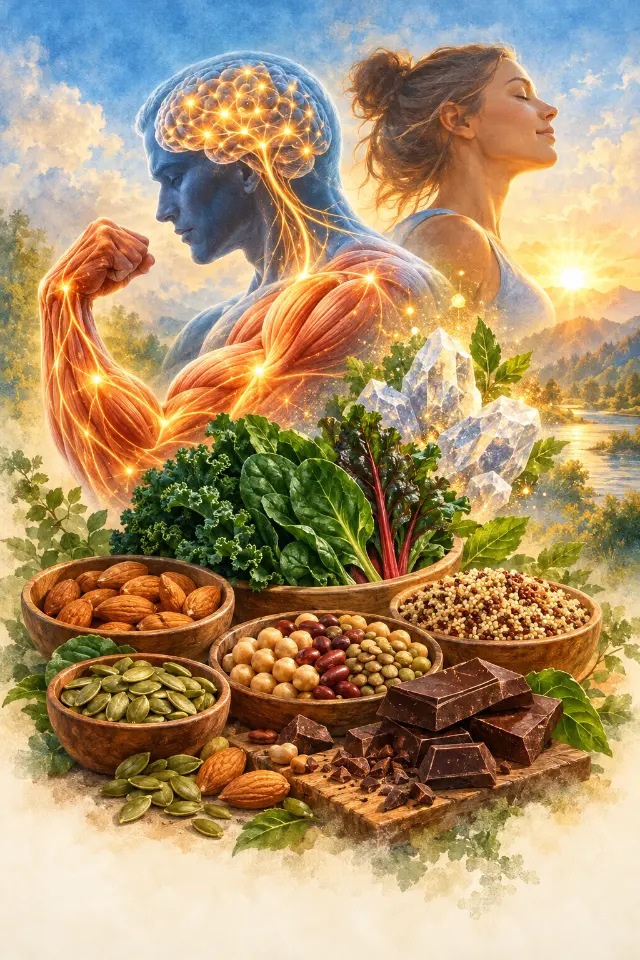
Fortunately, there are many natural food sources. The most valuable foods include: green vegetables; spinach; Swiss chard; almonds; walnuts; pumpkin seeds; sesame seeds; legumes; chickpeas; lentils; minimally processed cocoa. These foods have the advantage of providing not only magnesium but also many other protective nutrients.
In the Family Clinic approach, the goal is not to obsessively count the milligrams consumed each day. It is more useful to adopt a diet rich in natural, colorful and minimally processed foods. When vegetables, legumes, seeds and nuts regularly have a place on the plate, magnesium intake generally becomes more favorable.
Magnesium reminds us of an important lesson about health. The body’s major functions often rely on discreet elements that we barely notice when they are present, but whose absence eventually makes itself felt.
Taking care of your magnesium reserves means helping maintain your energy, your muscles, your brain, your sleep and your overall balance.
It is a small nutritional detail that can have major consequences for the quality of aging.
Family Clinic advice
Try to add at least one food naturally rich in magnesium every day: a handful of almonds, chickpeas, lentils, seeds or green vegetables. These simple habits, repeated over years, help build a foundation that favors energy, resistance to stress and the preservation of independence.