
Foreword
Endogenous depression is one of the most formidable conditions of the modern world. It differs from reactive depression, which occurs after an emotional shock, loss or identifiable trauma. In endogenous depression, no obvious external cause can be identified: it strikes people who apparently have a balanced life, a stable environment and satisfying social relationships. This absence of a trigger makes the disease particularly bewildering both for the patient and for those around them, who struggle to understand the origin of such intense suffering.
Epidemiologically, endogenous depression affects between 10 and 25% of women and 5 to 12% of men during their lifetimes. These figures reflect a high prevalence, making it one of the world's main causes of disability. Its consequences are numerous: lost productivity, social isolation, impaired quality of life and, in one case in five, a tragic outcome through suicide. Healthcare systems face a considerable burden, in terms both of care and of economic and human costs. Endogenous depression is not confined to individual suffering: it is a real public health problem.
Conventional treatments, developed since the mid-20th century, rely on tricyclic antidepressants, monoamine oxidase inhibitors and, subsequently, serotonin reuptake inhibitors (SRIs). These drugs have improved care, but provide only partial relief and rarely a definitive cure. Many patients remain trapped in fluctuating symptoms, with frequent relapses and prolonged dependence on pharmacological treatments. This therapeutic limitation invites exploration of new avenues.
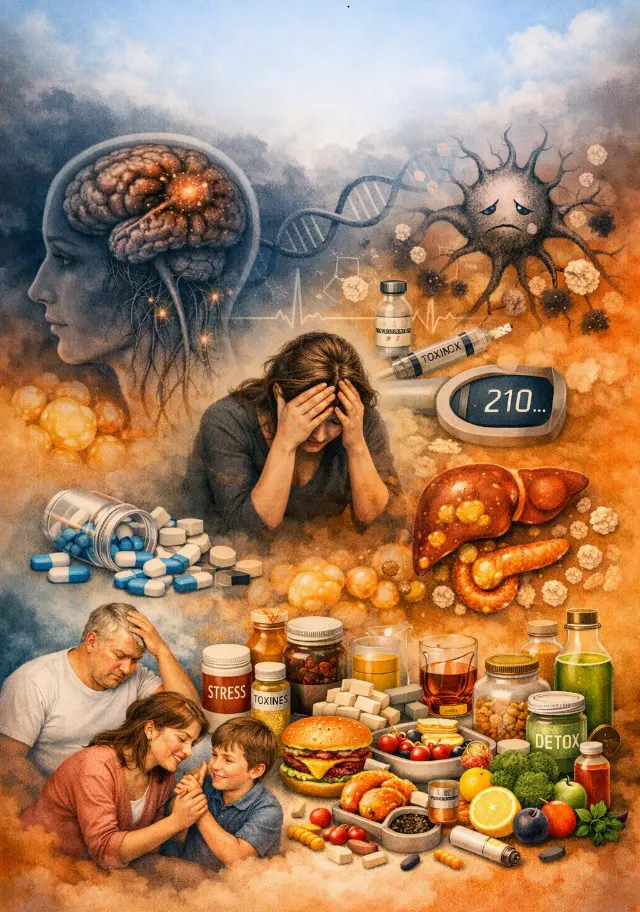
In this context, “cerebral accumulation” disorders offer an innovative interpretation. According to this hypothesis, neurons and astrocytes saturated with dietary and bacterial molecules experience a decrease in electrical and metabolic activity. This decrease causes a cascade of disturbances: reduced cerebral blood flow, reduced glucose metabolism and impaired limbic and prefrontal circuits. These abnormalities, observed through functional imaging, suggest that endogenous depression is linked more to cellular dysfunction than to a simple chemical disturbance of neurotransmitters.
Family Clinic reminds us that understanding disease is the first step towards health. Endogenous depression is not inevitable: it can be approached differently through appropriate nutritional reform. Food, too often neglected in therapeutic approaches, becomes a central tool here. By reducing harmful substance intake and favouring hypotoxic nutrition, it is possible to limit cellular accumulation and restore metabolic balance. This view opens a new path, complementary to conventional treatments, and restores hope to patients and their families.
Clinical presentation and symptoms
Endogenous depression manifests through a collection of clinical signs that, taken separately, might seem ordinary, but which together, when persistent, indicate a real disease. Its presentation is often insidious: patients do not understand what is happening to them, those around them minimise their difficulties or attribute them to a simple “low patch”, and diagnosis is delayed. Yet early recognition of symptoms is essential to avoid worsening and progression to a chronic condition.
- The first sign is persistent physical and intellectual fatigue. Patients feel exhausted on waking, unable to sustain effort, whether at work or at home. This fatigue does not disappear with rest and is accompanied by slowness of movement, thought and reactions. It reflects reduced neuronal and metabolic activity, a direct consequence of cerebral dysfunction.
- This fatigue is compounded by profound sadness, often unexplained. Unlike bereavement or emotional shocks, this sadness has no identifiable cause. It descends on patients like a leaden weight, preventing them from experiencing joy or pleasure. It is lasting, resistant to encouragement and accompanied by feelings of uselessness or unjustified guilt.
- Loss of interest in work and leisure is another major sign. Previously stimulating activities become a matter of indifference. Patients abandon hobbies, disengage from responsibilities and withdraw into themselves. This social disengagement deepens isolation and aggravates psychological suffering.
- Sleep disturbances are frequent: insomnia with nocturnal waking or hypersomnia with an excessive need to sleep. These disturbances increase fatigue and disrupt biological rhythms. They reflect an alteration of the brain circuits regulating sleep, particularly in the limbic cortex.
- Weight changes are also observed: loss of appetite and weight loss or, conversely, overeating and weight gain. These fluctuations reflect metabolic and hormonal dysregulation linked to cellular accumulation and neurotransmitter disturbance.
- Reduced libido is common, resulting from lower energy and impaired dopaminergic circuits. It adds relationship distress and may destabilise a couple's life together.
- Suicidal or delusional thoughts constitute the most serious sign. They reflect the intensity of the patient's distress and despair. They require urgent care, as the risk of acting on them is real.
- Finally, endogenous depression is accompanied by somatic manifestations: headaches, diffuse pain, palpitations, colitis. These bodily symptoms reflect the interconnection between brain and body and remind us that depression is a systemic disease.
Brain imaging examinations (functional MRI, PET scan) show few anatomical lesions, but reveal metabolic abnormalities: reduced blood flow and glucose metabolism in the limbic and prefrontal cortex. These findings confirm that endogenous depression is linked to cellular dysfunction rather than a simple, isolated chemical disturbance.
Family Clinic stresses the importance of recognising early symptoms. The sooner care begins, the greater the chances of improvement. Vigilance from loved ones and healthcare providers is therefore essential to guide patients towards appropriate help.
Accumulation hypotheses and the role of food
The human brain is an organ of remarkable complexity, whose functioning depends on close interaction between neurons and glial cells, particularly astrocytes. The latter perform essential functions: supplying glucose to neurons, regulating synaptic activity, participating in signal transmission and secreting growth molecules indispensable to brain plasticity. When these cells become saturated with dietary or bacterial waste, their efficiency decreases. This phenomenon, which Family Clinic calls “accumulation”, represents a new hypothesis for explaining certain cerebral dysfunctions, including endogenous depression.
Cerebral accumulation originates in the intestine. Normally, the intestinal barrier filters nutrients and prevents foreign molecules from passing through. But when the small intestine becomes excessively permeable — a phenomenon known as “leaky gut” — dietary peptides, bacterial fragments and toxins cross the barrier and enter the bloodstream. These substances reach the brain, where they accumulate in neurons and astrocytes. The consequence is reduced electrical and metabolic activity, reflected in reduced blood flow and glucose metabolism, abnormalities regularly observed in brain imaging.
This hypothesis sheds new light on the symptoms of endogenous depression. Persistent fatigue, unexplained sadness, sleep disturbances or loss of interest would be linked not solely to neurotransmitter imbalance, but to genuine cellular saturation. Deprived of energy efficiency, the brain operates more slowly. Limbic and prefrontal circuits, essential for emotional regulation and decision-making, become less active, explaining psychological suffering and loss of motivation.
Many patients report worsening symptoms after consuming certain foods: wheat, animal milk, industrial products rich in additives. These clinical observations reinforce the idea that food plays a decisive role. Conversely, hypotoxic nutrition — based on natural, raw or minimally processed products — improves overall health. Hypotoxic foods reduce foreign peptide intake and limit intestinal permeability, thereby reducing cerebral accumulation.
Accumulation disorders are not confined to the brain: they affect the whole body. Dietary and bacterial waste saturates tissues, disrupts metabolism and favours chronic inflammation. Because of its particular sensitivity, the brain suffers the most visible consequences. Endogenous depression thus appears as a systemic disease of which the brain is the primary victim.
Family Clinic encourages patients to consider food as a therapeutic tool. Identifying and reducing harmful foods is a key step towards restoring cerebral balance. Hypotoxic nutrition does not claim to replace conventional treatments, but acts on the disease's underlying causes. By reducing cellular accumulation, it restores neuronal activity and improves emotional stability. This innovative nutritional approach opens a complementary path based on education and patient empowerment.
Results of the hypotoxic diet and conclusion
Clinical observations collected from patients with endogenous depression who adopted a hypotoxic diet are particularly encouraging. Although this approach does not claim to replace conventional pharmacological treatments, it acts deeply on cellular and metabolic mechanisms, offering lasting and sometimes spectacular improvement.
- Many patients report a progressive reduction in fatigue. Where waking was marked by overwhelming heaviness, they regain more stable energy over the weeks. This improvement reflects restored cerebral metabolism, a direct consequence of reduced cellular accumulation. Freed of some dietary and bacterial waste, neurons and astrocytes resume normal activity, reflected in better alertness and increased concentration.
- Profound, unexplained sadness also lessens. Patients describe a gradual return of joy in living, a regained ability to experience pleasure in everyday activities and a reduction in negative thoughts. This development is crucial because it restores hope and confidence, two essential elements in breaking out of the depressive vicious circle.
- Sleep disturbances improve considerably. Insomnia decreases, nocturnal awakenings become less frequent and excessive hypersomnia lessens. Biological rhythms rebalance, allowing patients restorative sleep. This phenomenon is linked to regulation of the brain circuits involved in sleep, which regain efficiency through better cellular nutrition.
- Emotional stability represents another major benefit. Several patients report fewer mood fluctuations and better resistance to stress. Resuming a hypotoxic diet rich in natural products and low in toxins favours more harmonious neurotransmitter regulation. This stability reduces relapse risk and allows a calmer return to social and professional life.
It should be emphasised that hypotoxic nutrition complements conventional treatments. Antidepressants remain necessary in many cases, but their effectiveness is enhanced by an appropriate diet. Dietetics does not merely mask symptoms: it acts on underlying causes by reducing cellular accumulation and restoring metabolic balance. This integrative approach opens the way to more comprehensive medicine, where pharmacology and nutrition combine to offer patients better quality of life.
Family Clinic highlights the importance of education and personalised support. The aim is not merely to prescribe a diet, but to help patients and their families understand disease mechanisms, identify harmful foods and gradually adopt healthier eating. This educational approach encourages adherence and perseverance, indispensable conditions for lasting results.
In conclusion, although endogenous depression is a serious and disabling disease, it is not inevitable. By understanding its connection with accumulation disorders and adopting a hypotoxic diet, patients can hope for significant improvement in their condition. This innovative nutritional approach, founded on science and clinical experience, restores hope to those who believed themselves condemned to suffer. It offers a complementary, humane and accessible path to restore cerebral balance and regain a dignified quality of life.
Family Clinic invites every patient to incorporate this nutritional reform into daily life, assured of attentive and appropriate support. Mental health is not confined to medication: it is also built on the plate, at the heart of everyday life.