
Foreword
Schizophrenia remains one of the most mysterious and feared psychiatric diseases. It is characterised by loss of contact with reality, auditory or visual hallucinations, sometimes overwhelming delusions and profound disorganisation of thought and behaviour. Affecting around 1% of the world population, it represents a major cause of psychological disability, particularly affecting adolescents and young adults when their social and professional lives should be flourishing. Families facing this disorder often experience a painful journey marked by incomprehension, stigma and uncertainty about the future.
Current drug treatments — principally neuroleptics — constitute an undeniable advance and remain indispensable for reducing acute symptoms. However, their effectiveness remains partial: they do not always prevent progression towards gradual dementia or deterioration in quality of life. Many patients remain trapped in dependency, oscillating between remission phases and relapses without a truly lasting solution. This therapeutic limitation invites exploration of other complementary avenues capable of addressing the disease's underlying mechanisms.
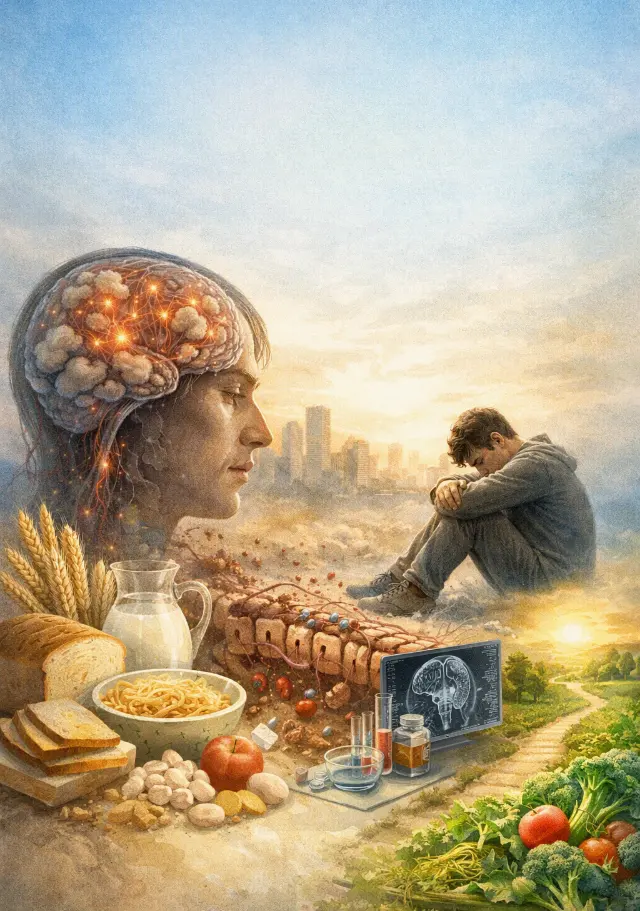
In this context, the concept of cerebral accumulation brings a new perspective. According to this hypothesis, certain brain cells — neurons and astrocytes — can become progressively saturated by dietary or bacterial molecules from an intestine that has become excessively permeable. This phenomenon, called intestinal hyperpermeability, allows protein or toxic fragments to cross the digestive barrier and circulate to the brain. Their accumulation would disrupt cellular metabolism, alter synaptic communication and cause structural abnormalities responsible for psychotic symptoms.
This biological interpretation opens a new field of investigation: schizophrenia would not simply be genetic inevitability or an isolated chemical disorder, but the result of a complex interaction between hereditary constitution, environment and food. Modern cereals, particularly mutated wheat and its derivatives, appear as major suspects. Their excessive consumption, combined with cooking methods that denature proteins, could favour cerebral accumulation and amplify psychiatric problems.
This booklet forms part of Family Clinic's mission: offer patients and their loved ones clear educational tools based on scientific data and clinical observations to understand chronic diseases' hidden mechanisms. The aim is not to deny conventional treatments' importance, but to propose a complementary approach centred on hypotoxic nutrition and restoration of intestinal balance.
By exploring links between schizophrenia and dietary factors, we wish to restore hope to families. Understanding that food can influence disease progression opens the possibility of practical action: reduce harmful intake, favour protective foods and support patients towards better quality of life.
Family Clinic reminds us that schizophrenia is not simply genetic inevitability. It can be modulated by environment and food, offering a new path for prevention and support.
Clinical presentation and scientific data
Schizophrenia is a complex psychiatric disorder distinguished by characteristic symptoms. It manifests through discordance of intellectual functions, loss of personality unity, a break with reality marked by hallucinations and illusions, and delusions centred on an inner world. As disease progresses, it often leads to insidious dementia, depriving patients of cognitive and social capacities.
Conventional clinical descriptions highlight disorganised thinking, impaired language, incoherent behaviour and inability to maintain a stable social or professional life. Patients may experience acute phases with hallucinations and agitation, followed by calmer periods marked by emotional withdrawal and loss of initiative. This alternation makes disease difficult to manage and contributes to family exhaustion.
Brain imaging provides tangible evidence of organic damage: temporal-lobe atrophy, reduced grey matter, decreased total brain volume. These abnormalities confirm that schizophrenia is not simply a functional or psychological disorder, but an organic disease involving structural brain alterations.
Genetically, much research has shown hereditary predisposition. However, concordance in monozygotic twins is only 50%. In other words, even when two people share exactly the same genetic inheritance, only one in two will develop disease. This observation highlights environmental factors' importance in schizophrenia genesis. Heredity alone cannot explain clinical forms' diversity or variability of progression.
Among these environmental factors, food occupies a growing place in research. Epidemiological studies show that certain populations, depending on eating habits, have higher schizophrenia rates. Diets rich in modern cereals, dairy products and processed foods appear to favour symptom onset or worsening. Conversely, periods of food restriction, such as during wars, have been associated with fewer hospitalisations for schizophrenia.
Immunological data reinforce this hypothesis: a significant proportion of patients with schizophrenia have antigliadin antibodies, indicating an immune reaction against gluten. Furthermore, intestinal hyperpermeability is frequently observed, allowing toxic molecules into the bloodstream and ultimately the brain. These elements suggest that schizophrenia could partly result from a metabolic and immune disorder linked to food and intestinal barrier condition.
Schizophrenia thus appears as a multifactorial disease:
- Genetic factors: hereditary predisposition, but not determinative.
- Environmental factors: food, infections, stress, toxin exposure.
- Biological factors: brain abnormalities, immune disturbances, cellular accumulation.
Family Clinic emphasises that schizophrenia is not solely genetic inevitability. Environment, particularly food, can influence its onset and progression.
Dietary hypotheses and accumulation
For several decades, researchers have proposed that certain foods, particularly modern cereals such as wheat, rye and barley, could play a role in schizophrenia genesis or aggravation. Long marginalised, this hypothesis now attracts growing interest through clinical and immunological data highlighting links between food, intestinal permeability and psychiatric disorders.
Arguments supporting this thesis are numerous:
- Animal experiments showed that cats force-fed wheat developed a neurological condition analogous to human schizophrenia.
- During wartime periods, when cereal consumption was greatly reduced, hospitalisations for schizophrenia decreased significantly.
- A study comparing 45 different populations revealed a striking correlation between wheat consumption and schizophrenia frequency.
- In some patients with schizophrenia, intestinal hyperpermeability was observed, facilitating harmful molecules' passage into the bloodstream.
- Finally, antigliadin antibodies — indicating an immune reaction against gluten — are detected in around 20% of people with schizophrenia, versus only 3% of healthy controls.
These observations converge towards a coherent hypothesis: through modified protein structure and cooking methods, modern cereals increase intestinal permeability. They thus allow protein or toxic fragments to cross the digestive barrier and reach the brain. Once in the central nervous system, these molecules can saturate neurons and astrocytes, causing cerebral accumulation. This process disrupts synaptic communication, alters energy metabolism and favours psychotic symptom onset.
Accumulation is not merely passive waste build-up: it is a true metabolic disorder. Brain cells saturated with foreign molecules lose their ability to regulate neurotransmitters. Dopamine, often implicated in schizophrenia, may be produced or degraded abnormally, increasing hallucinations and delusions. Furthermore, chronic inflammation induced by these molecules increases brain lesions and accelerates progression towards dementia.
This dietary hypothesis does not challenge genetic factors, but complements them. It explains why some people with hereditary predisposition develop disease only after prolonged exposure to diets rich in mutated cereals and processed foods. It also illuminates observed population differences: where traditional nutrition rests on fresh plant foods, legumes and non-mutated cereals, schizophrenia is less common.
Family Clinic stresses the importance of rethinking food for at-risk patients. Reducing mutated and cooked cereal consumption and favouring raw or minimally processed plant foods constitutes a simple, accessible and safe preventive measure.
Results of the hypotoxic diet and conclusion
Clinical observations accumulated over decades confirm the hypotoxic diet's value in schizophrenia care. Although not an exclusive treatment, its complementary role appears increasingly evident. Several studies and clinical accounts highlight encouraging results:
- Among patients with schizophrenia placed on a wheat-free diet, 45% experienced remission, versus only 17% among those continuing to consume cereals.
- In one reported case, a woman with schizophrenia and coeliac disease recovered from both conditions after eliminating cereals.
- Other observations show improved emotional stability, fewer hallucinations and better quality of life in patients adopting hypotoxic nutrition.
The hypotoxic diet rests on simple but powerful principles: drastic reduction of mutated cereals and dairy products, limitation of processed foods and priority to plant foods raw or cooked at low temperatures. This nutritional approach aims to decrease inflammation, restore intestinal permeability and reduce intake of harmful molecules liable to accumulate in the brain.
This diet's value extends beyond schizophrenia alone. By improving intestinal functioning and reducing exposure to mutated proteins, it acts on mechanisms shared by several chronic diseases: autoimmune disorders, digestive conditions, neurodegenerative diseases. In schizophrenia specifically, it offers a new path for prevention and support alongside drug treatments.
It must be remembered that food does not replace conventional psychiatric care. Neuroleptics and therapies remain indispensable for stabilising patients and preventing acute attacks. However, incorporating a nutritional approach addresses underlying causes by reducing cerebral accumulation and improving nervous-system resilience.
Families, often overwhelmed by disease, find hope in this strategy. Changing food is an accessible, safe approach that can be implemented progressively. It restores loved ones' active role in care by involving them in meal preparation and daily follow-up.
Family Clinic offers appropriate nutritional support alongside conventional treatments to help patients with schizophrenia and their families regain hope and quality of life.
Conclusion
Schizophrenia is a complex, multifaceted and profoundly disabling disorder. It cannot be reduced to simple genetic inevitability or an isolated chemical disturbance. Clinical, immunological and nutritional data converge towards broader understanding: disease results from interaction between hereditary constitution, environment, food and the brain's metabolic state.
The cerebral accumulation hypothesis offers an innovative interpretive key. It suggests that neurons and astrocytes saturated by dietary or bacterial molecules from an excessively permeable intestine progressively lose efficiency. This process alters synaptic communication, favours inflammation and disrupts neurotransmitter regulation, particularly dopamine, directly implicated in psychotic symptoms.
This approach helps explain why drug treatments, although indispensable, do not always suffice to halt disease progression. They act on symptoms, but rarely on underlying causes. Conversely, an appropriate nutritional strategy can help reduce accumulation, restore intestinal balance and improve nervous-system resilience.
Hypotoxic diet results are encouraging: fewer hallucinations, improved emotional stability, partial or complete remissions in some cases. Of course, this is not a universal panacea, but a complementary tool deserving incorporation into comprehensive care. By reducing mutated cereal, dairy and processed-food intake, and favouring raw or lightly cooked plant foods, it is possible to act on biological mechanisms involved in schizophrenia.
Beyond scientific data, this approach restores families' active role. Changing food is an accessible, progressive and safe approach. It allows loved ones to participate practically in care, regain a form of hope and contribute to improving patients' quality of life.
Family Clinic reminds us that schizophrenia is not simply genetic inevitability. It can be modulated by environment and food, opening a new path for prevention and support.
In conclusion, schizophrenia should be considered multifactorial, with genetics, environment and food interacting. Although still under exploration, the cerebral accumulation hypothesis offers a promising perspective. It invites moving beyond a reductive view of a purely psychiatric disorder towards a comprehensive biological and nutritional approach.
This booklet forms part of Family Clinic's mission: provide educational, practical and accessible tools to understand chronic diseases' hidden mechanisms and propose concrete avenues for prevention and support. It does not claim to replace conventional treatments, but to enrich them with nutritional and educational dimensions.
By combining medical advances, psychological therapies and nutritional strategies, it thus becomes possible to offer patients with schizophrenia and their families more complete, more humane and hopeful care.