
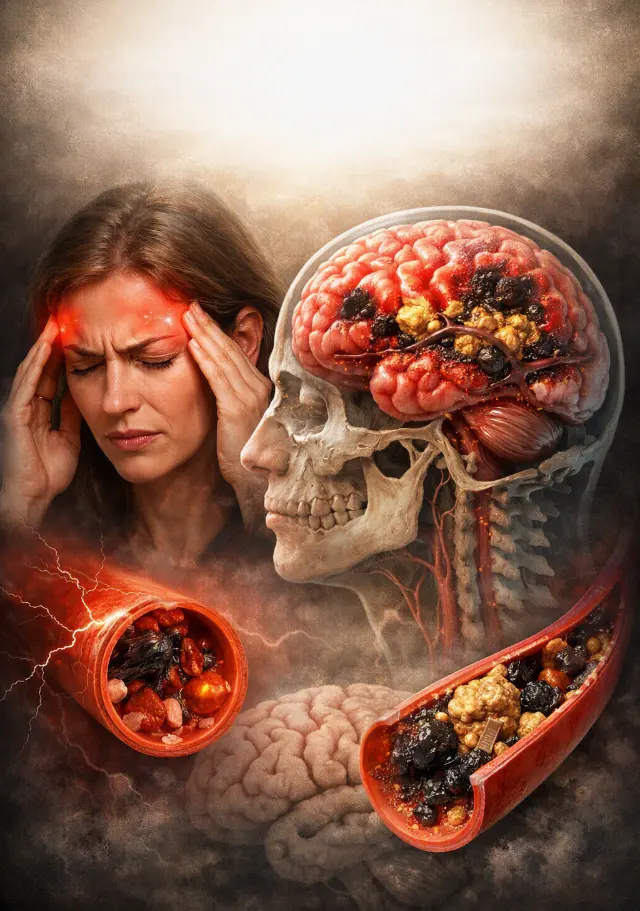
- Foreword – Understanding cerebral pain in the context of accumulation
Headaches, whether migraine, tension-type or mixed, are now among the most frequent reasons for medical consultation. They affect all social classes and ages, intensifying with modern life's pace: stress, industrial food, pollution, lack of sleep. Behind this apparent ordinariness lies a complex biological reality: the brain, an organ of extreme metabolic sensitivity, can suffer progressive cellular accumulation comparable to that observed in peripheral tissues during chronic diseases.
Cerebral accumulation means the build-up of unwanted molecules — altered proteins, oxidised lipids, bacterial fragments, metabolites from incomplete digestion — infiltrating the brain's extracellular environment. Often originating in a diet too rich in processed products or an intestine that has become permeable, these substances disrupt neuronal and astrocyte communication. Astrocytes, true brain support cells, normally regulate synapses, take up glucose and protect neurons against toxins. When saturated, their filtering and regulatory capacity collapses: the brain becomes slow, irritable and painful.
Long ignored, this hypothesis sheds new light on headache pathophysiology. Pain would result not only from neuronal hyperexcitability or vasodilation, but also from intracerebral metabolic imbalance. Deprived of a clean environment, neurons respond with chaotic discharges; inflamed astrocytes release mediators sustaining pain. This vicious circle explains many migraines' chronic nature and resistance to conventional treatments.
The Family Clinic approach proposes placing these phenomena within a comprehensive perspective: the brain is not isolated from the rest of the body. It experiences the effects of food, microbiota, liver and immune system. Appropriate nutritional reform — termed hypotoxic — can restore cerebral clarity, reduce attack frequency and improve quality of life. This method rests on gentle detoxification, reduction of pro-inflammatory foods and rehabilitation of cellular metabolism.
This booklet addresses both patients and healthcare professionals wishing to understand the hidden mechanisms behind persistent headaches. It is not simply a compilation of dietary advice, but a physiological reflection on how lifestyle influences cerebral health. By following hypotoxic nutrition principles, everyone can address pain's underlying causes: cleanse biological conditions, ease the toxic burden and restore the brain's self-regulatory capacity.
Family Clinic continues its mission here: offer educational tools to transform understanding of chronic diseases. Headaches are not inevitable; they are the body's language, a warning signal indicating that the nervous system calls for a return to balance. This guide will help you decipher this language, identify accumulation factors and implement a coherent nutritional strategy.
Regaining a pain-free life begins with understanding why the brain suffers.
Clinical description of headaches
Migraines
Migraine is a chronic neurological condition affecting around 12% of the population, with marked female predominance (four women for one man). It most often begins before age 40 and is characterised by recurring attacks of intense head pain. This pain is generally throbbing, bilateral or sometimes unilateral, and worsens with physical effort or exposure to sensory stimuli. Attacks last from a few hours to several days, causing major functional incapacity.
Associated symptoms vary: nausea, vomiting, photophobia (light intolerance), phonophobia (noise intolerance), hypersensitivity to smells. In some cases, an aura precedes pain: it may be visual (scintillating scotoma, bright spots, zigzag lines), sensory (tingling, numbness), motor (transient limb weakness, temporary hemiplegia) or cognitive (concentration problems, disorientation). Aura reflects a transient disturbance of neuronal and astrocyte activity, often linked to temporary cortical depression.
Migraine is therefore much more than a simple headache: it constitutes a systemic disease involving the central nervous system, vascular system and cellular metabolism. Modern research shows astrocytes play a key role in attack genesis: accumulation within them disrupts synaptic regulation and favours inflammatory mediator release.
Tension-type headaches
Even more frequent than migraine, tension-type headaches represent the most widespread form of head pain. They produce bilateral, diffuse, non-throbbing pain described by patients as tightness, a helmet-like sensation or compression around the head. Often less intense than migraines, their chronic, recurring nature nevertheless makes them a major public health problem.
Unlike migraines, they are not accompanied by neurological or digestive symptoms. They are strongly linked to stress, fatigue, prolonged postures and neck muscle tension. However, the Family Clinic approach emphasises that these headaches are not solely mechanical in origin: they also reflect metabolic accumulation in the nervous system, making brain cells more vulnerable to external demands.
Tension-type headaches should therefore be understood as a warning signal: saturated with dietary and metabolic waste, the brain loses adaptive capacity and expresses its suffering through persistent pain.
Limitations of conventional treatments
Current drug treatments (analgesics, anti-inflammatory drugs, triptans, beta blockers, ergot derivatives) provide temporary relief but do not prevent recurrences. They act on symptoms without correcting underlying causes. Furthermore, repeated use exposes patients to side effects: gastritis, liver problems, drug dependence, medication-overuse headaches.
Complementary approaches (relaxation, acupuncture, osteopathy, biofeedback) offer partial benefit but remain insufficient for patients with chronic migraines or recurring tension-type headaches. This therapeutic impasse invites exploration of other avenues: nutrition, lifestyle, detoxification.
Family Clinic reminds us that understanding disease is the first step towards healing. Headaches should be considered a biological signal indicating internal imbalance rather than inevitable. By targeting cerebral accumulation, the nutritional approach opens a new path: address causes rather than symptoms alone.
This chapter shows that headaches, whether migraine or tension-type, reflect cerebral suffering linked to complex mechanisms. Conventional treatments relieve but do not cure. The accumulation hypothesis offers a coherent explanation and opens the way to innovative nutritional care.
Accumulation hypotheses and foods' role
Modern neurobiology and brain imaging research has revealed an intriguing phenomenon: during a migraine attack, transient neuronal and astrocyte depression is observed, meaning a sudden drop in brain cells' electrical and metabolic activity. This observation led to formulating a new hypothesis: cellular accumulation.
Cerebral accumulation
Accumulation means progressive build-up of unwanted molecules in the brain's extracellular and intracellular environments. These molecules mainly come from two sources:
- Modern food rich in rapidly absorbed sugars, saturated fats, processed animal proteins and chemical additives.
- The intestinal microbiota, which, when unbalanced, produces toxins and increases digestive wall permeability.
When the intestine becomes permeable, dietary and bacterial fragments enter the bloodstream and reach the brain. Astrocytes, true guardians of the nervous system, become saturated with this waste. Their normal role — regulate synapses, secrete growth factors, store glucose — is compromised. The result is reduced neuronal efficiency, disrupted synaptic communication and chronic inflammation.
Astrocyte vulnerability
Astrocytes represent around half of brain cells. They nourish neurons, regulate neurotransmitters and protect against toxins. But their storage and filtering capacity is limited. When saturated:
- Synaptic communication becomes chaotic, favouring disordered electrical discharges responsible for migraines.
- Growth-factor secretion reduces, weakening neurons and slowing regeneration.
- Glucose storage is disrupted, depriving neurons of their main energy source.
Astrocyte accumulation therefore constitutes a true pathophysiological key to chronic headaches. It explains why some patients remain resistant to conventional treatment: as long as metabolic conditions are not cleansed, attacks repeat.
Foods' triggering role
Many patients report certain attacks being triggered by specific foods: milk, wheat, eggs, wines, processed meats. Double-blind clinical studies confirmed this food sensitivity. It is not conventional allergy (absence of specific IgE), but a reaction linked to accumulation. Molecules in these foods — modified proteins, poorly digested peptides, additives — accumulate in the brain and disrupt its functioning.
This observation leads to an important conclusion: food is a major headache trigger. It does not merely provoke a digestive reaction, but acts directly on cerebral metabolism. Patients must therefore receive support in identifying harmful foods and establishing a protective diet.
Family Clinic approach
Family Clinic stresses the importance of connecting headaches with eating habits. Far beyond prescribing medication, the approach proposes nutritional reform:
- Exclude pro-inflammatory and saturating foods (animal milk, modern wheat, refined sugars).
- Favour hypotoxic foods: raw or warm vegetables, fresh fruit, legumes, quality vegetable oils.
- Restore intestinal balance through a diet rich in fibre and natural probiotics.
This strategy aims to reduce the toxic burden, free astrocytes from saturation and restore the brain's self-regulatory capacity. Headaches then become less frequent, less intense and sometimes disappear completely.
This chapter shows that cerebral accumulation is a coherent pathophysiological hypothesis connecting food, microbiota and pain. Foods play a major triggering role, and only appropriate nutritional reform can break chronic headaches' vicious circle.
Results of the hypotoxic diet and conclusion
Clinical studies and observations
Results obtained by applying the hypotoxic diet are remarkable and deserve detailed analysis. Several cohorts of patients with migraine or tension-type headaches were followed under strict nutritional protocols. Data show that exclusion of certain foods — principally modern wheat, maize, animal milk and their derivatives — causes spectacular symptom improvement.
Among 88 children with severe migraine, avoiding these foods achieved healing in more than 90% of cases. Previously frequent and disabling attacks disappeared or reduced to rare, moderate episodes. This result is all the more significant because it concerns a paediatric population often difficult to treat with conventional medication.
Among 57 adults with migraine, 93% saw attacks disappear or markedly lessen after adopting the hypotoxic diet. Tension-type headaches showed a favourable response in more than 90% of cases. These figures far exceed conventional drug treatment effectiveness, which provides only partial and temporary relief.
Mechanisms of action of the hypotoxic diet
The hypotoxic diet's success is explained by several pathophysiological mechanisms:
- Reduced toxic burden: eliminating saturating foods frees the brain from unwanted molecules clogging astrocytes.
- Restoration of intestinal balance: reducing dairy products and wheat decreases digestive permeability and limits dietary fragments' passage into the bloodstream.
- Improved neuronal communication: cleared of accumulated waste, astrocytes regain their ability to regulate synapses and supply glucose to neurons.
- Reduced inflammation: avoiding pro-inflammatory foods reduces cytokine and pain-mediator release.
The hypotoxic diet thus acts directly on headaches' underlying causes rather than symptoms alone.
Testimonials and clinical feedback
Many patients report a radical transformation in quality of life:
- Disappearance of disabling attacks.
- Improved sleep and concentration.
- Reduced medication use.
- Regained freedom, without permanent fear of another attack.
These testimonials confirm that hypotoxic nutrition is not a mere theory but a tangible clinical reality. It restores patients' active role in health by involving them in daily food choices.
Conclusion – Towards a new understanding of headaches
Headaches, whether migraine or tension-type, are not simple passing pains: they reflect profound suffering of the nervous system. Although effective in the moment, conventional treatments fail to prevent recurrence because they do not address the fundamental cause: cerebral accumulation.
Linked to modern food and intestinal permeability, this process causes astrocyte saturation and disrupted neuronal communication. Consequently, the brain loses its self-regulatory capacity and expresses distress through painful attacks.
By reducing the toxic burden and restoring intestinal balance, the hypotoxic diet offers a lasting solution. Clinical results are eloquent: disappearance or marked reduction of attacks in more than 90% of cases. This nutritional approach restores patients' active role in health by involving them in daily food choices.
Family Clinic reminds us that understanding disease is the first step towards healing. Headaches should be seen as a warning signal rather than inevitable. Through appropriate nutritional reform, it becomes possible to transform this signal into an opportunity for health and regain a life free of pain. Headaches reflect internal imbalance. By addressing cerebral accumulation through hypotoxic nutrition, everyone can hope not only to relieve pain, but also durably strengthen cerebral balance and quality of life.