
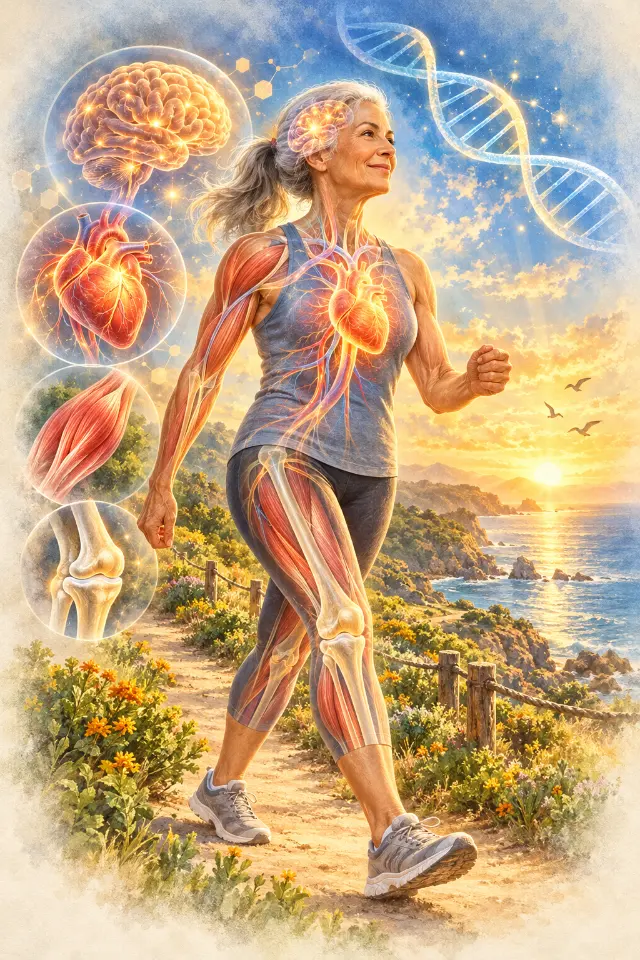
If researchers had to name a single habit able to simultaneously improve the health of the heart, arteries, muscles, brain, bones and even the immune system, they would probably choose physical activity.
This claim may seem surprising. Many people still associate exercise with weight loss or improving their physical appearance. Yet its benefits go far beyond that. Physical activity is today one of the most effective tools for slowing the effects of aging.
The human body was never designed to stay seated for long hours. For thousands of years, human beings have walked, carried, climbed, farmed, built and moved about every day. Movement is written into our biology.
When we stop moving, the body interprets this inactivity as a signal to adapt. Gradually, the muscles lose strength, breathing capacity declines, the joints become stiffer and the cardiovascular system loses efficiency.
Conversely, every physical activity acts as a message sent to the whole body: “Stay strong. Stay capable. Keep maintaining your abilities.” This stimulation is essential at any age but becomes particularly important after fifty.
Many people think it is pointless to start a physical activity as they get older. This is a common mistake. Studies show, on the contrary, that benefits can be observed even in people who have been sedentary for several decades.
The body has a remarkable capacity to adapt. Someone who starts walking regularly after sixty can improve their physical condition, reduce their cardiovascular risk and gain independence. A person who begins strength-training exercises after seventy can still increase their strength and improve their balance.
Age is therefore not a contraindication to movement. On the contrary, it is one more reason to stay active. One of the first organs to benefit from exercise is the heart. Like any muscle, the heart grows stronger when it is regularly put to work. As training progresses, it becomes able to pump more blood with each beat. This improvement allows better delivery of oxygen to all the tissues.
The consequences are numerous:
- less breathlessness;
- improved endurance;
- faster recovery after exertion;
- reduced risk of cardiovascular disease;
- better quality of daily life.
The blood vessels also benefit from this adaptation. They retain more flexibility, which helps maintain good blood circulation and more balanced blood pressure.
But the benefits of exercise are not limited to the cardiovascular system. The brain also benefits dramatically from physical activity. When we walk, run or cycle, blood flow to the brain increases. Neurons receive more oxygen and nutrients. Certain molecules that promote the growth and protection of nerve cells are released. These adaptations help maintain memory, attention and learning abilities.
Physical activity is today considered one of the best non-drug strategies for supporting cognitive function during aging.
The muscles are another major concern. From around fifty onward, muscle mass naturally declines. This gradual loss is called sarcopenia. If nothing is done, it can lead to fatigue, weakness, a higher risk of falls and a loss of independence.
Exercise acts directly against this phenomenon. Every muscle contraction stimulates biological mechanisms that favor maintaining or increasing muscle mass. Even simple exercises done regularly can produce impressive results.
Contrary to a widespread belief, it is not necessary to go to a gym to enjoy these effects. The most useful activities are often the most accessible:
- brisk walking;
- gardening;
- climbing stairs;
- cycling;
- swimming;
- bodyweight exercises;
- gentle gymnastics;
- dancing.
What matters is consistency. It is better to walk thirty minutes every day than to do an intense sport just once a month.
Specialists also stress the importance of cutting down on long periods of sitting. A person can do a daily workout and still be too sedentary if they then spend the rest of the day sitting in front of a screen.
It is advisable to get up regularly, walk for a few minutes, do a few movements or change position several times during the day. These simple actions, repeated daily, help preserve many physiological functions.
Beyond all the biological benefits, physical activity also brings psychological advantages that are often underestimated. Active people frequently describe:
- a better mood;
- less stress;
- more restorative sleep;
- greater confidence in their abilities;
- an increased sense of well-being.
Over time, these improvements also contribute to a better quality of life.
Aging well is therefore not only about watching your diet or taking nutritional supplements. Movement remains one of the fundamental pillars of longevity.
- Every step taken today is an investment in the years to come.
- Every walk nourishes the heart.
- Every effort stimulates the brain.
- Every muscle contraction preserves independence.
And every active day helps build a future that is stronger, more independent and more serene.
Family Clinic advice
Don’t try to become an athlete. Try to become someone who moves every day. Consistency is often worth more than intensity. A brisk daily walk kept up for ten years generally brings more benefits than an ambitious exercise program abandoned after a few weeks.