

Foreword
Fibromyalgia is a disabling chronic condition, long misunderstood and often relegated to the category of psychosomatic disease. Yet it affects a significant proportion of the adult population, mainly women, and has a major impact on quality of life. Since the Copenhagen Declaration in 1992, it has been officially recognized as a real disease.
This booklet is part of the Family Clinic approach, which aims to make complex medical knowledge accessible through clear, structured, educational presentation. It offers a new interpretation of fibromyalgia: that of a disease of accumulation, a concept developed by Dr. Seignalet.
We will examine:
- Characteristic symptoms and diagnostic difficulties.
- Proposed pathophysiological mechanisms, particularly the accumulation theory.
- The limitations of conventional drug treatments.
- The results of the hypotoxic diet, the only approach to have shown lasting effectiveness.
This document is designed as a practical tool for patients, families, and healthcare professionals. It does not claim to replace a medical consultation but provides reliable guidance for understanding the disease and directing its management.
Definition and symptoms
General definition
Fibromyalgia (FM) is a chronic condition characterized by widespread pain, persistent fatigue, and sleep disturbances. Long considered a psychosomatic entity, it is now recognized as a real organic disease. Its prevalence is estimated at approximately 4% of women and 0.4% of men, predominantly between ages 20 and 40.
Main symptoms
The clinical presentation rests on a triad of symptoms:
- Widespread pain: it involves muscles, tendons, and joints. It is intense, occurs day and night, and worsens with exertion, without radiological abnormalities or inflammatory signs.
- Intense fatigue: both physical and cognitive, causing intolerance of activity and a significant reduction in quality of life.
- Nonrestorative sleep disturbances: sleep is fragmented, punctuated by multiple awakenings, and provides no rest.
Associated manifestations
Fibromyalgia frequently comes with secondary symptoms that add to its disabling nature:
- Chronic headaches or migraines.
- Irritable bowel syndrome and functional digestive disorders.
- Irritable bladder with frequent urination.
- Dysmenorrhea (painful periods).
- Nervousness, anxiety, irritability.
- Sensitivity to cold with Raynaud's phenomenon.
- Restless legs syndrome.
- Nighttime cramps.
Diagnostic criteria
Diagnosis relies on exaggerated sensitivity at 22 tender points distributed over the body (occiput, trapezius, epicondyle, sacroiliac region, trochanter, knee, Achilles tendon, etc.).
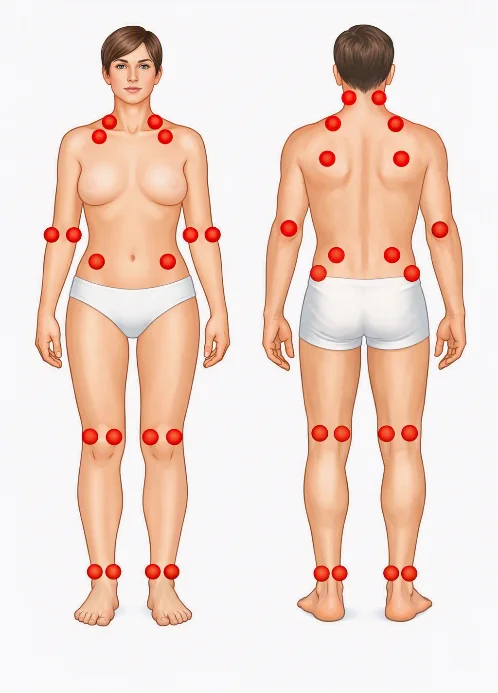
Pain at at least 14 points is considered significant.
Laboratory and radiological findings
Laboratory and radiological tests are generally normal, explaining diagnostic difficulty and initial medical skepticism. However, certain metabolic abnormalities have been described:
- ATP deficiency.
- Reduced phosphocreatinine.
- Glycolysis abnormalities.
- Magnesium deficiency.
Functional imaging findings (MRI) show reduced cerebral blood flow. Muscle performance is diminished: strength reduced by 39%, static endurance by 81%. These findings confirm that fibromyalgia is an organic disease rather than simply a psychological construction.
Differential diagnosis and disease course
Obstacles to diagnosis
Diagnosing fibromyalgia remains difficult for several reasons:
- Medical lack of knowledge: the disease was only officially recognized in 1992 and remains inadequately taught in conventional curricula.
- Dominant symptoms: an isolated painful focus (for example, lower back pain or a headache) can mask the overall picture.
- Persistent denial: some practitioners still consider patients hypochondriacs or people with masked depression, delaying clinical recognition.
Differential diagnoses to consider
Fibromyalgia can be confused with other conditions, requiring a rigorous approach:
- Inflammatory rheumatic conditions: generally identifiable through laboratory abnormalities (ESR, CRP) and radiological findings.
- Spasmophilia: often associated but distinct, characterized by neuromuscular hyperexcitability.
- Mitochondrial mutations: responsible for muscle pain and fatigability, detectable by biopsy and genetic sequencing.
- Chronic fatigue syndrome (CFS): similar symptoms, but distinguished by onset following viral illness or vaccination, intermittent fever, and throat pain.
The natural course of the disease
Longitudinal studies show a chronic, persistent course:
- Pain remains constant, without spontaneous remission.
- Fatigue remains disabling and severely limits everyday activities.
- Sleep disturbances persist, worsening the overall symptoms.
Thus, fibromyalgia appears to be a condition incurable through conventional treatments, generating frustration in patients and a sense of helplessness in doctors.
Pathophysiological hypotheses
Several mechanisms have been proposed to explain the disease:
- Inflammatory origin: unconfirmed, because laboratory markers (ESR, CRP) remain normal.
- Sensory origin: hypersensitivity to pain, with substance P levels tripled in cerebrospinal fluid.
- Central origin: sleep disturbances considered an initiating factor, causing fatigue and pain. Stress is recognized as an aggravating factor.
Limitations of drug treatments
Conventional therapies prove disappointing:
- Anti-inflammatory drugs and analgesics: ineffective.
- Low-dose antidepressants: partial effects on sleep and pain, but no cure.
- Metabolic approaches (thiamine, magnesium, phosphocreatinine, salbutamol, triiodothyronine): inconsistent, nonreproducible results.
This chapter highlights fibromyalgia's resistance to conventional treatments and the need for a new approach. The accumulation theory, presented in the next chapter, offers a coherent explanation and opens an original therapeutic path.
The accumulation theory
Origin of the concept
Dr. Jean Seignalet proposed an innovative explanation of fibromyalgia: the accumulation theory. According to this hypothesis, dietary and bacterial molecules insufficiently broken down in the small intestine cross the intestinal barrier and enter the bloodstream. They gradually accumulate in certain tissues, disrupting their function without causing cellular destruction or conventional inflammation.
Target cells of accumulation
Three cell types appear particularly vulnerable:
- Myocytes (muscle cells): their energy metabolism is impaired, causing exercise intolerance, reduced muscle strength, and widespread pain.
- Tenocytes (tendon cells): unable to produce collagen, elastin, and proteoglycans properly, they generate tendon pain, morning stiffness, and reduced joint flexibility.
- Neurons and astrocytes (brain cells): their functioning becomes ‘defective,’ inducing fatigue, sleep disturbances, headaches, nervousness, and sometimes a tendency toward depression.
Clinical and laboratory consequences
This slow accumulation explains several characteristics of fibromyalgia:
- Onset in adulthood: the tolerance threshold is exceeded after years of dietary and environmental exposure.
- Absence of visible lesions: cells have disrupted function but are rarely destroyed.
- Minimal inflammation: immunogenic peptides are poorly represented, explaining normal laboratory markers (ESR, CRP).
- Metabolic abnormalities: ATP deficiency, reduced phosphocreatinine, and cerebral hypoxia, interpreted as consequences of accumulated waste blocking certain cellular mechanisms.
Imaging findings and interpretation
Brain imaging tests (functional MRI) show reduced blood flow in certain regions. This hypoperfusion can be understood as an adaptive reaction by cells burdened by accumulation: inability to regulate energy supply or establishment of a defense mechanism intended to reduce their activity.
Scope of the theory
The accumulation theory provides a coherent explanation for:
- The diversity of symptoms (muscular, tendinous, neurological).
- The absence of conventional laboratory markers.
- The ineffectiveness of conventional drug treatments (analgesics, anti-inflammatory drugs, antidepressants).
It opens the way to a therapeutic approach focused on the presumed cause rather than the consequences: reducing accumulation through a suitable diet.
Results of the hypotoxic diet
Therapeutic context
Faced with the failure of conventional drug treatments (analgesics, anti-inflammatory drugs, antidepressants, metabolic approaches), a nutritional strategy was explored: the hypotoxic diet. This rests on the idea that certain poorly broken-down modern dietary molecules contribute to cellular accumulation. By reducing their intake, it might be possible to restore normal tissue function.
Clinical study
Dr. Jean Seignalet followed 80 patients (72 women and 8 men, mostly young adults) placed on a hypotoxic diet for periods ranging from 1 to 10 years. The observed results are remarkable:
- 58 clear successes: complete disappearance of fibromyalgia signs, with lasting remissions.
- 10 marked improvements: improvement estimated at approximately 75%.
- 4 partial improvements: improvement around 50%.
- 8 failures: no notable benefit.
Thus, 90% of patients observed improvement, including 72.5% with complete remission.
How results develop
- Favorable effects generally appear after a few weeks.
- They gradually increase, stabilizing between three months and two years.
- With a lapse in the diet, moderate symptoms reappear.
- If the diet is completely abandoned, relapse is almost constant after a few weeks or months.
Nature of remission
This is not a definitive cure but a conditional remission: the threat remains if modern eating patterns resume. In practice, continuing the diet allows a normal life without pain or disabling fatigue.
Additional advantages
Beyond fibromyalgia, the hypotoxic diet offers preventive benefits:
- Anti-aging action.
- Cancer prevention.
- Reduced risk of atherosclerosis.
- Fewer allergies.
This is proof that the hypotoxic diet is the only strategy capable of transforming the prognosis of fibromyalgia by acting directly on the presumed cause — accumulation — rather than merely on the consequences.
Final synthesis
Nature of the disease
Fibromyalgia is a chronic, real, organic condition with coherent, persistent symptoms. It is distinguished by a clinical triad (widespread pain, intense fatigue, sleep disturbances) and a series of associated manifestations that reinforce its disabling nature. The absence of conventional laboratory or radiological abnormalities explains diagnostic difficulty and initial medical skepticism.
Contribution of the accumulation theory
The accumulation theory provides an overall, coherent explanation:
- Poorly broken-down dietary and bacterial molecules cross the intestinal barrier and accumulate in tissues.
- Myocytes experience impaired energy metabolism, generating pain and exercise intolerance.
- Tenocytes produce insufficient collagen and elastin, causing tendon pain and morning stiffness.
- Disrupted neurons and astrocytes induce fatigue, sleep disturbances, and nervousness.
This concept sheds light on the absence of visible lesions, variability of metabolic abnormalities, and ineffectiveness of conventional treatments.
Therapeutic impact of the hypotoxic diet
The hypotoxic diet represents a major advance:
- It acts directly on the presumed cause (reduction of accumulation).
- It allows lasting remission in 90% of patients, with complete disappearance of symptoms in more than 70% of cases.
- Benefits appear rapidly and stabilize within a few months.
- Relapse is almost constant when the diet is abandoned, confirming the link between the disease and modern nutrition.
Preventive scope
Beyond fibromyalgia, the hypotoxic diet offers additional advantages:
- Anti-aging effect.
- Cancer prevention.
- Reduced risk of atherosclerosis.
- Fewer allergies.
Conclusion: Fibromyalgia perfectly illustrates a disease of accumulation: a slow buildup of foreign molecules that disrupts cellular functioning without causing destruction or inflammation. Nutritional management opens a new therapeutic path, transforming a disease considered incurable into a controllable, reversible state.