
Foreword
Gout is an ancient disease, described since antiquity by Hippocrates, Galen, and other doctors who already associated it with dietary excess and wealth. It was long nicknamed the ‘disease of kings’ or ‘disease of the rich,’ because it mainly affected those who consumed abundant meat, wine, and refined dishes. Yet behind this historical image lies a much broader reality: gout is a common metabolic disease that can affect anyone exposed to an overload of uric acid, regardless of social status.
Today, it affects approximately 3% of men and 0.5% of women, predominantly after age 30. It is considered one of the most painful and disabling joint conditions. Patients describe nighttime attacks so intense that they wake them abruptly, unable to place their foot on the floor or even tolerate contact with a sheet. This pain, often misunderstood by those around them, causes anxiety, isolation, and loss of mobility.
At Family Clinic, we know that gout is more than a joint disease: it is a systemic disorder that perfectly illustrates the accumulation theory. Uric acid, a product of purine breakdown, accumulates in the blood and eventually precipitates as crystals. These deposit in joints, triggering a violent inflammatory reaction. Gout thus becomes a symbol of a saturated body unable to eliminate its metabolic waste properly.
This booklet aims to explain, in simple words and concrete examples, the mechanisms of gout, its connection with diseases of accumulation, and practical solutions for preventing and relieving it. We want to show that gout is not an inevitable fate: a nutritional and preventive approach can transform patients' lives.
Our approach rests on three pillars:
- Understanding: clearly explain what happens in the body.
- Prevention: identify triggers and avoid them.
- Support: offer concrete solutions adapted to each patient.
At Family Clinic, we believe knowledge is the first step toward healing. Understanding your disease already means regaining control. This booklet is designed as a practical guide: it will accompany you step by step, from the biological mechanism to dietary advice, to help you regain freedom and comfort in life.
Presentation and circumstances of onset (extended version)
Gout is a condition that most often appears after age 30, a period when metabolism begins to show signs of overload. The first attacks occur suddenly, often at night, and surprise patients with their intensity. The affected joint becomes red, hot, swollen, and extremely painful. The big toe is the most typical location, but the disease can also affect the ankle, knee, wrist, or elbow.
This nighttime pattern is not incidental: it reflects a time when the body, slowed by rest, struggles to eliminate excess uric acid accumulated during the day. Crystals then precipitate in the joint, triggering sudden inflammation. The patient wakes in the middle of the night, unable to put their foot on the floor or move their hand. The pain is described as ‘searing,’ ‘intolerable,’ sometimes compared to a burn or fracture.
The circumstances of onset are well known:
- Dietary excess: consumption of red meat, organ meats, seafood, cured meats, and alcohol.
- Dehydration: insufficient water, heavy sweating without replacement of fluids.
- Fatigue or stress: which promote crystal precipitation.
- Taking certain medications: diuretics or treatments that raise blood uric acid.
These attacks generally last several days, then resolve spontaneously. But they recur regularly if the cause is not treated. Repeated attacks establish a permanent fear: many patients live in anxiety about the next episode, fearing they may no longer be able to walk or work.
At Family Clinic, we see patients who tell us: ‘I sleep in fear of being woken by pain.’ This fear is real and disabling. Our role is to show them that gout is not an inevitable fate: understanding triggers and adapting diet and lifestyle can considerably reduce attack frequency.
We emphasize an essential point: diet plays a major role. Many patients do not realize that their everyday habits — too much meat, a glass of alcohol, insufficient hydration — can be enough to trigger an attack. Gout is therefore a disease in which prevention is possible and effective. Understanding your disease is the first step toward controlling it. At Family Clinic, we help you identify risk factors and establish concrete solutions to regain peace of mind.
The accumulation mechanism in gout (extended version)
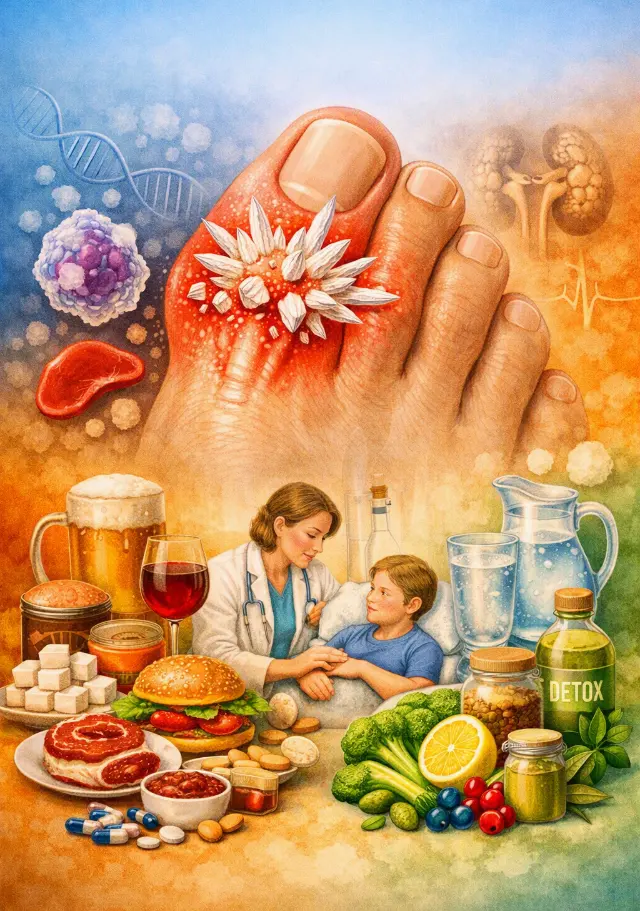
Gout is the clearest example of what we call a disease of accumulation. Uric acid, a product of the breakdown of purines contained in certain foods (red meat, organ meats, seafood, alcohol, but also some legumes and sugary drinks), normally circulates in the blood and must be eliminated by the kidneys. When production is too high or elimination insufficient, its blood concentration exceeds a critical threshold.
At this stage, uric acid no longer remains soluble: it precipitates as sodium urate crystals. These microscopic crystals, with sharp edges, accumulate in joints, tendons, and sometimes the kidneys. Their presence is perceived by the immune system as an attack. White blood cells try to phagocytose them but fail. As they break apart, they release powerful inflammatory mediators (interleukins, prostaglandins, TNF-alpha), responsible for pain, swelling, and local warmth.
This process explains why gout is a disease of accumulation:
- Joints become a site for deposits of harmful molecules.
- The saturated body can no longer eliminate its waste properly.
- Inflammation is the direct consequence of this accumulation.
The image is telling: joints behave like ‘metabolic waste bins’ in which toxic crystals pile up. Every attack results from an overflow, an excess that the body can no longer manage.
This mechanism also explains the chronic nature of the disease. As long as uric acid remains high, deposits continue to accumulate. Attacks recur, joints become damaged, and complications appear (tophi, kidney failure).
At Family Clinic, we explain this process with clear diagrams and educational booklets. Understanding that gout is not simply ‘joint pain’ but a sign of metabolic overload helps patients accept a different treatment based on diet and lifestyle.
We emphasize an essential point: gout mirrors overall accumulation in the body. It is not confined to the painful joint: it reveals a profound metabolic imbalance. Management must therefore be comprehensive rather than solely symptomatic.
Symptoms and disease course (extended version)
Gout presents with sudden joint attacks, often at night, that surprise patients with their intensity. The pain is described as unbearable, preventing any movement, sometimes making it impossible simply to put a foot on the floor or tolerate contact with a sheet. The affected joint becomes red, hot, swollen, and hypersensitive.
Typical symptoms include:
- Searing pain: comparable to a burn or fracture.
- Local inflammation: visible redness, warmth, and swelling.
- Extreme hypersensitivity: the slightest contact triggers sharp pain.
- Functional limitation: inability to walk, grasp an object, or bend the joint.
Initially, attacks are spaced apart: one or two per year. But without treatment, they become more frequent, sometimes monthly, and affect several joints. The disease then progresses to a chronic form, in which inflammation persists even between attacks.
Over time, crystal deposits called tophi appear under the skin, around joints, in tendons, or in the ears. These nodules, sometimes visible to the naked eye, deform joints and limit mobility. The kidneys can also be affected: crystals deposit there, causing stones or progressive kidney failure.
This progression illustrates the seriousness of gout: it is not simply transient pain but a disease that can compromise mobility and kidney function. Untreated patients risk progressive disability.
At Family Clinic, we offer comprehensive care: nutritional assessment, personalized advice, and regular monitoring. We know gout pain is among the most intense in rheumatology. That is why we support our patients step by step, with clear explanations and concrete solutions.
Our approach aims to:
- Reduce attack frequency through an appropriate diet.
- Limit progression toward chronic disease through active prevention.
- Preserve kidney function through hydration and medical monitoring.
- Restore patients' confidence by showing them they can act on their disease.
The role of the hypotoxic diet
The hypotoxic diet is one of the pillars of gout management. It rests on a simple idea: reduce intake of purines and harmful molecules responsible for metabolic accumulation. In practice, this means profoundly changing the diet to limit uric acid formation and promote its elimination.
Purine-rich foods — red meat, organ meats, cured meats, seafood, some legumes, and alcoholic drinks — are the main causes of elevated blood uric acid. Regular consumption causes metabolic overload, reflected in crystal precipitation within joints. Conversely, a hypotoxic diet based on fresh plant products, suitable whole grains, quality plant oils, and abundant hydration can significantly reduce this risk.
Results observed in patients adopting this diet are encouraging:
- A marked reduction in attack frequency: some patients go from several attacks per year to one or two widely spaced attacks, or none at all.
- Reduced pain intensity: when attacks occur, they are less severe and shorter.
- Prevention of long-term complications: tophus formation and kidney involvement are limited.
- Overall improvement in metabolism: better energy, easier digestion, and reduced chronic inflammation.
An essential point must be emphasized: benefits appear quickly, sometimes within the first few weeks. But if the diet is abandoned, relapse is almost constant. This confirms the direct link between diet and gout. Consistency and discipline are therefore essential.
At Family Clinic, we have incorporated this diet into our protocols. We support patients through dietary transition, because changing habits is never simple. We offer:
- Simple recipes suited to everyday life.
- Practical booklets explaining which foods to favor and which to avoid.
- Medical and nutritional monitoring to adjust the diet to individual needs.
- Practical workshops to learn to cook differently without sacrificing pleasure.
We emphasize the importance of hydration: drinking plenty of water helps the kidneys eliminate uric acid. Gentle physical activity (walking, stretching, yoga) complements this approach by improving metabolism and reducing inflammation.
Synthesis and prevention
Gout is a painful, disabling disease, but it should not be considered an inevitable fate. Its accumulation mechanism explains why it becomes chronic and resistant to conventional treatments: as long as uric acid accumulates, crystal deposits persist and attacks recur. The true solution therefore lies in prevention, which directly addresses the cause rather than only the symptoms.
Prevention rests on several complementary elements:
- Hypotoxic diet
- Limit purine intake by reducing red meat, organ meats, cured meats, seafood, and alcohol.
- Favor a plant-based diet rich in fiber, fresh vegetables, suitable grains, and quality plant oils.
- Introduce simple, tasty recipes that preserve the pleasure of eating while reducing accumulation.
- Abundant hydration
- Drink water regularly throughout the day to promote uric acid elimination by the kidneys.
- Avoid sugary drinks and sodas, which increase the metabolic burden.
- Favor mild herbal teas or lemon water, which support metabolism.
- Gentle, regular physical activity
- Walking, yoga, stretching, or swimming improve circulation and stimulate waste elimination.
- Physical activity should remain moderate: intense exertion can promote dehydration and trigger an attack.
- Regular medical monitoring
- Blood tests to monitor blood uric acid.
- Kidney monitoring to prevent complications.
- Adjustment of treatments according to disease progression.
This new perspective transforms management: rather than being limited to relieving attacks, it addresses the cause. The joint regains part of its function, and the patient regains freedom of movement. Prevention becomes a tool for reclaiming health.
At Family Clinic, we believe health comes through understanding and prevention. Our booklets, consultations, and practical workshops are designed to help you regain control of your health. We support our patients step by step, giving them concrete tools to change their everyday lives.
Conclusion
Gout is an ancient disease that remains relevant today and perfectly illustrates the accumulation theory. It is not confined to joint pain: it reveals a profound metabolic imbalance, an inability of the body to eliminate its waste properly. Violent, repeated attacks are the visible sign of invisible accumulation.
This booklet has shown that gout is not an inevitable fate. Understanding its mechanism, identifying the circumstances of onset, and adopting a hypotoxic diet can reduce attack frequency and intensity. Prevention then becomes the true key: abundant hydration, appropriate diet, gentle physical activity, and regular medical monitoring.
Gout reminds us that health is a fragile balance but also that everyone can act to preserve it. By changing their lifestyle, patients gradually regain mobility, comfort, and confidence. Management should not be limited to pain relief: it should aim to restore freedom of movement and protect vital organs, particularly the kidneys.
At Family Clinic, we believe knowledge is the first step toward healing. Our booklets, consultations, and practical workshops are designed to support you on this path. Gout can be controlled: all that is needed is to learn to recognize its mechanisms and act on its causes.